

AeroPress vs Pour Over Coffee: Flavor & Brew Guide
Table of Contents
- AeroPress vs Pour Over: Which Brewing Method Wins?
- AeroPress vs Pour Over: Flavor Profile Breakdown
- Brewing Mechanisms: Immersion vs Percolation
- Ease of Use, Cleanup, and Portability Compared
- How to Brew Pour Over Coffee at Home
- The Best Coffee Grind Size for AeroPress
- Which One Should You Choose?
- Frequently Asked Questions
Last Updated: September 8, 2026
The debate between AeroPress and pour over coffee isn't about which gadget looks better on your counter. It's about what kind of cup you want to drink every morning. The AeroPress uses pressure and immersion to build a bold, full-bodied brew in under two minutes, while a pour over dripper like the Hario V60 relies on gravity to produce a bright, tea-like cup that highlights delicate flavor notes. At USM Coffee, we roast every batch to order, and the brewer you choose changes how those fresh flavors present themselves. Below, we'll break down the flavor profiles, brewing mechanics, and practical trade-offs so you can pick the method that fits your routine.
Here is the short version: choose the AeroPress for speed, durability, and a forgiving brew that travels well. Choose pour over when you want a clean, nuanced cup and enjoy the ritual of manual brewing. This guide from USM Coffee covers grind sizes, step-by-step recipes, and the one factor most comparisons miss: water chemistry.
AeroPress vs Pour Over: Which Brewing Method Wins?
Neither method is objectively superior, but each wins decisively in specific scenarios. The AeroPress Original is a pressure-based immersion brewer that excels at producing a concentrated, espresso-style cup with minimal cleanup. Pour over brewers like the Hario V60 Ceramic Dripper are gravity-fed systems designed to extract bright, clean, and complex flavor notes from specialty beans.
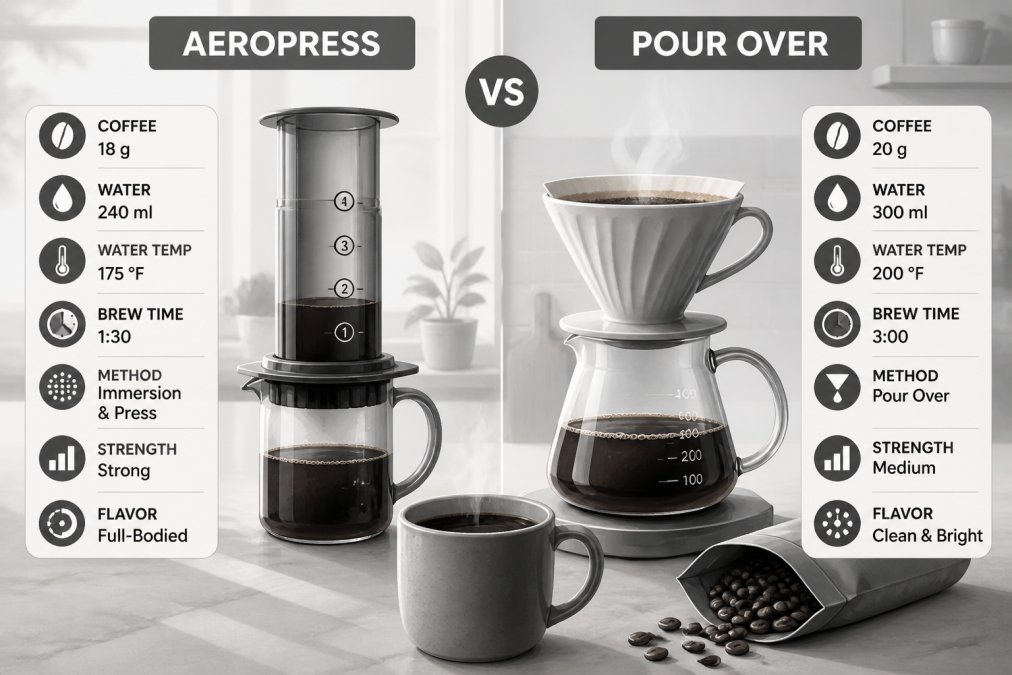
The AeroPress wins for travelers, campers, and anyone who wants great coffee without fuss. Its lightweight, BPA-free plastic construction is nearly indestructible, and cleanup takes seconds. The pour over wins for home baristas who want maximum control over extraction and enjoy the meditative process of a slow, careful pour.
AeroPress vs Pour Over: Flavor Profile Breakdown
The flavor differences between AeroPress vs pour over coffee come down to how each method handles oils and fine particles. The AeroPress uses paper micro-filters that trap sediment and most oils, producing a clean cup with a heavier body and lower acidity than you might expect from immersion brewing. Because the brew chamber is sealed and pressure forces water through the coffee, you get a denser, more concentrated extraction that carries chocolatey and nutty notes well.
Pour over methods like the V60 and Chemex produce a distinctly lighter cup. The thick paper filters in a Chemex, for instance, remove nearly all oils and sediment, resulting in a crisp, tea-like body that lets floral and fruity acidity shine. The V60's spiral ribs allow coffee to expand during the bloom, which supports even extraction and highlights sweetness. If you prefer a silky texture with noticeable mouthfeel, the AeroPress delivers. If you want a clean cup with high clarity and pronounced acidity, pour over is the answer.
Brewing Mechanisms: Immersion vs Percolation
Understanding the brewing mechanism explains why the same beans taste so different between these two methods. The AeroPress is an immersion brewer: coffee grounds sit fully submerged in water, and after a short steep, you press the plunger to force the brew through a filter. This method is highly forgiving because extraction happens evenly across all grounds at once, with less sensitivity to pouring technique.
Pour over brewing relies on percolation, where water flows through a bed of coffee grounds by gravity. This is what coffee professionals call bypass brewing territory, where water can channel through paths of least resistance if your pour is uneven. Channeling leads to over-extracted bitter spots and under-extracted sour spots in the same cup. That is why a gooseneck kettle is strongly recommended for V60 brewing: precise flow rate control prevents channeling and keeps extraction consistent.
Specialty Coffee Association brewing fundamentals outlines how extraction yield and total dissolved solids shift between immersion and percolation methods, which is worth reading if you want to understand the science behind your cup.
Ease of Use, Cleanup, and Portability Compared
The AeroPress is famously forgiving, which makes it the better choice for beginners. The full brewing process takes under two minutes, and the recipe tolerates minor variations in grind size and water temperature without producing a bitter cup. The AeroPress Go packs everything into a built-in mug that doubles as a carrying case, making it the obvious pick for travel.
Pour over requires more practice. You need to master the bloom, maintain a steady pour rate, and control water temperature. A consistent grind from a burr grinder is essential because uneven particles extract at different rates. Cleanup is straightforward, but the ceramic V60 is fragile, and the Chemex's glass body demands careful handling. The Chemex also uses proprietary bonded filters that cost more than standard paper filters over time.
| Feature | AeroPress Original | Hario V60 | Chemex |
|---|---|---|---|
| Starting Price | $39.95 | $25.00 - $35.00 | $45.00 - $55.00 |
| Brew Time | Under 2 minutes | 3-4 minutes | 4-5 minutes |
| Body | Full, bold | Light, clean | Very light, tea-like |
| Portability | Excellent | Poor | Poor |
| Learning Curve | Low | Steep | Moderate |
| Best For | Travel, speed | Flavor clarity | Multiple cups |
What most comparisons ignore is the long-term environmental footprint of each method. This is the angle no other guide covers, and it matters if you brew daily. The AeroPress uses one paper micro-filter per brew. Those filters are compostable, but they are also bleached in some versions, look for unbleached natural paper filters to avoid introducing chlorine compounds into your compost. Over a year of daily brewing, that is roughly 365 filters, or about 0.4 pounds of paper waste.
Pour over methods vary significantly. A Hario V60 uses standard paper filters, similar in environmental impact to AeroPress filters. A Chemex, however, uses bonded filters that are thicker and heavier, about 50 percent more paper by weight per filter than a V60 filter. Over a year, Chemex brewing generates roughly 0.6 pounds of paper waste. The bonding process also means these filters are not always compostable in home compost systems, depending on the specific bonding agent used.
Metal filters offer an alternative for both methods. The AeroPress has aftermarket stainless steel mesh filters, such as those from Able Brewing, that eliminate paper waste entirely. The trade-off is that metal filters let more oils and fine sediment through, producing a fuller-bodied cup with more mouthfeel. For pour over, a metal filter like the Able Kone for V60 changes the flavor profile significantly, you get a heavier cup with more sediment, which defeats the clarity that draws many people to pour over in the first place.
If environmental impact is your priority, the calculation is straightforward. The AeroPress with a reusable metal filter produces zero ongoing waste and is the most sustainable option. The AeroPress with paper filters produces modest waste that is compostable if you choose unbleached filters. Pour over with paper filters produces slightly more waste, and the Chemex's bonded filters are the least environmentally friendly option. The plastic body of the AeroPress is a one-time manufacturing cost, while ceramic and glass pour over devices have a higher manufacturing footprint but last indefinitely if handled carefully.
How to Brew Pour Over Coffee at Home
A reliable pour over recipe starts with fresh beans and a proper water-to-coffee ratio. Use a 1:16 ratio, meaning 30 grams of coffee to 480 grams of water, which produces a balanced cup for most palates. Heat your water to around 200°F, just off a full boil.
- Rinse the paper filter with hot water to remove paper taste and preheat the dripper.
- Add ground coffee and create a small well in the center.
- Pour twice the coffee weight in water (about 60 grams) to bloom the grounds. Wait 30 to 45 seconds for gas to escape.
- Pour in slow, concentric circles from the center outward, keeping the water level below the dripper rim.
- Aim to finish your pour by the 2:30 mark and let the bed drain by 3:30 to 4:00 total.
Water chemistry matters more than most guides admit. Hard water with high mineral content can dull acidity, while soft water can make coffee taste flat. National Science Foundation water quality research explains how dissolved minerals affect extraction. If your tap water tastes strongly of chlorine or minerals, filtered water will noticeably improve your cup.
The Best Coffee Grind Size for AeroPress
Grind size is the single most important variable separating a good AeroPress cup from a great one, yet most guides leave you guessing with vague terms like "medium-fine." Here is the precision most articles skip: for the AeroPress, you are targeting a particle size between 400 and 800 microns. That is roughly the texture of fine table salt or granulated sugar. To visualize it, spread a pinch on a white plate, individual particles should be clearly visible but feel gritty between your fingers, not powdery.
Why this range? The AeroPress's immersion brewing extracts evenly because all grounds are fully submerged. However, the short contact time, typically 1 to 2 minutes, means you need enough surface area for proper extraction. Grind finer than 400 microns and you risk over-extraction, which shows up as a harsh, astringent bitterness. Grind coarser than 800 microns and the water cannot pull enough soluble flavor compounds, leaving you with a weak, sour cup.
A common pattern among experienced users is to start at 600 microns and adjust based on taste. If your brew tastes hollow or salty, grind finer. If it tastes sharp or drying, grind coarser. The forgiving nature of the AeroPress means you have a wider window than pour over, but that does not mean grind consistency is optional.
Baratza brewing grind guide provides a useful visual reference for dialing in your grind across different brewers.
Here is a practical way to check your grind without a micrometer: take a small sample and compare it to common kitchen references. Table salt is roughly 400 to 600 microns. Granulated sugar is closer to 500 to 700 microns. If your grounds look like a mix of both, you are in the right zone. If you see large boulders or fine dust, your grinder is producing an inconsistent particle distribution, which will cause uneven extraction no matter how careful you are with your recipe.
A burr grinder is essential for consistency. Uneven grounds extract at different rates, and micro-fines can slip through and add unwanted bitterness. The AeroPress paper micro-filters catch most sediment, but grind consistency still shapes the flavor. Start with a medium-fine setting and adjust based on taste rather than following a rigid chart.
The AeroPress also supports recipe scalability: you can brew a concentrated shot and dilute it with hot water, which is perfect for adjusting strength without changing your ratio. When scaling up, keep the grind size constant, only the coffee dose and water volume change. This is one area where the AeroPress beats pour over, which requires a coarser grind as you increase batch size to avoid clogging the filter.
Which One Should You Choose?
Choose the AeroPress if you value speed, durability, and simplicity. It is the better option for travelers, campers, and busy mornings when you want a bold, full-bodied cup without cleaning up a mess. The AeroPress Go adds portability with its all-in-one mug design.
Choose pour over if you want to highlight the nuanced flavors of fresh, specialty coffee. The V60 rewards practice with a clean, bright cup, while the Chemex is ideal for brewing several cups at once. Both require a gooseneck kettle and a quality burr grinder to reach their potential.
For either method, the coffee itself matters most. Freshly roasted beans from trusted farms make a measurable difference in flavor, which is why USM Coffee roasts every batch to order. Whether you prefer the bold intensity of an AeroPress or the clarity of a pour over, starting with beans roasted for maximum aroma and character elevates the final cup.
Choosing between AeroPress and pour over coffee ultimately comes down to your priorities: speed and portability versus flavor clarity and ritual. Both methods produce excellent coffee when paired with freshly roasted beans and a consistent grind. USM Coffee delivers freshly roasted coffee straight to your door, with beans sourced from trusted farms worldwide and roasted to order for maximum flavor and aroma. Get started with USM Coffee and taste the difference fresh beans make in your daily brew.
Frequently Asked Questions
Is AeroPress coffee better than pour over coffee?
Better depends on your taste and routine. The AeroPress produces a bold, full-bodied cup with low acidity and no sediment, thanks to its immersion brewing and paper micro-filters. Pour over methods like the V60 highlight bright, clean, and complex flavor notes with a lighter body. If you prefer a rich, forgiving brew under two minutes, the AeroPress wins. If you enjoy the ritual and want to taste the subtle characteristics of fresh-roasted beans, pour over is the better match.
What is the best coffee grind size for AeroPress?
A medium-fine grind, similar to table salt, is the best starting point for the AeroPress. This size balances extraction yield and flow rate for a standard brew time of about two minutes. If your coffee tastes bitter, try a slightly coarser grind. If it tastes sour or weak, go finer. Because the AeroPress is forgiving, you can adjust the grind to fine the flavor profile you enjoy. A burr grinder is recommended for consistent grind size.
Does the AeroPress produce a cleaner cup than a pour over?
Yes, the AeroPress generally produces a cup with less sediment and a thicker body. Its paper micro-filters trap fine particles and oils effectively. While pour over brewers like the V60 also use paper filters for a clear cup, the Chemex uses thicker filters that remove even more oils and sediment, resulting in a very light, tea-like body. The AeroPress's pressure-based extraction creates a silky texture that many find cleaner than a standard pour over.
How do I brew pour over coffee at home without special equipment?
You need a dripper, paper filters, a kettle, and a scale for the best results. Start by heating water to about 200°F. Place the filter in the dripper and rinse it with hot water. Add a medium-fine grind of coffee, using a 1:16 water-to-coffee ratio. Pour a small amount of water to bloom the grounds for 30 seconds. Then, pour the remaining water in slow, circular motions. The total brew time should be around three minutes.