

At Home Coffee Bar Ideas for Small Spaces That Work
Table of Contents
- Why Your Small Kitchen Needs a Coffee Bar (and How to Design One)
- Coffee Bar Essentials Checklist: What You Actually Need
- Small Coffee Station Organization: Maximize Every Inch
- DIY Coffee Bar Cart Ideas for Flexible, Rental-Friendly Setups
- Vertical Storage and Wall Shelves: Use the Space You Overlook
- Styling Your Coffee Corner: Decor That Keeps Counter Clutter Down
- Common Small-Space Coffee Bar Mistakes to Avoid
- Build Your Home Cafe: Final Thoughts on Small-Space Coffee Bars
- Frequently Asked Questions
Last Updated: September 6, 2026
Why Your Small Kitchen Needs a Coffee Bar (and How to Design One)
A well-planned at home coffee bar ideas for small spaces setup turns a cramped morning routine into a moment you actually look forward to. The challenge isn't lack of space; it's lack of strategy. Most people scatter their gear across three cabinets and a countertop, which creates clutter and adds friction to what should be a two-minute process.
The goal of a compact coffee station is simple: everything you need within arm's reach, nothing you don't in the way.
A small coffee bar is a designated prep area that consolidates your brewing equipment, beans, and accessories into one efficient footprint. It works because it respects your kitchen layout instead of fighting it. Below, we'll show you exactly how to build one, from the essentials checklist to rental-friendly carts that require zero drilling.
Coffee Bar Essentials Checklist: What You Actually Need
Before buying anything, separate the necessities from the nice-to-haves. A focused coffee bar essentials checklist keeps counter clutter down and your budget intact.
The non-negotiables:
- Your brewing method (espresso machine, pour-over kettle, or drip maker)
- A grinder if you use whole beans
- Coffee storage that blocks light and air
- Two or three everyday mugs
- A small tray to define the zone and catch drips
Skip these until you have room:
- Syrup dispensers and flavor bottles you rarely touch
- A dedicated mug tree if you only rotate three mugs
- Specialty tools like milk frothers that duplicate what your machine does
A compact coffee station works best when every item earns its place. If you haven't used something in two weeks, it's storage clutter, not a coffee bar essential.
Small Coffee Station Organization: Maximize Every Inch
Countertop space is the scarcest resource in a small kitchen, but the real goal isn't just fitting everything in, it's arranging it so your morning routine flows without wasted motion. Most guides tell you to use risers and shelves, but they never explain why the sequence of your gear matters more than its vertical placement.
Think of your coffee station as a three-zone assembly line: Prep, Brew, and Serve. In a tight footprint, these zones should follow your dominant hand's natural path. If you're right-handed, the workflow should move left to right: beans and grinder on the left, the machine in the center, and your mug and milk on the right.
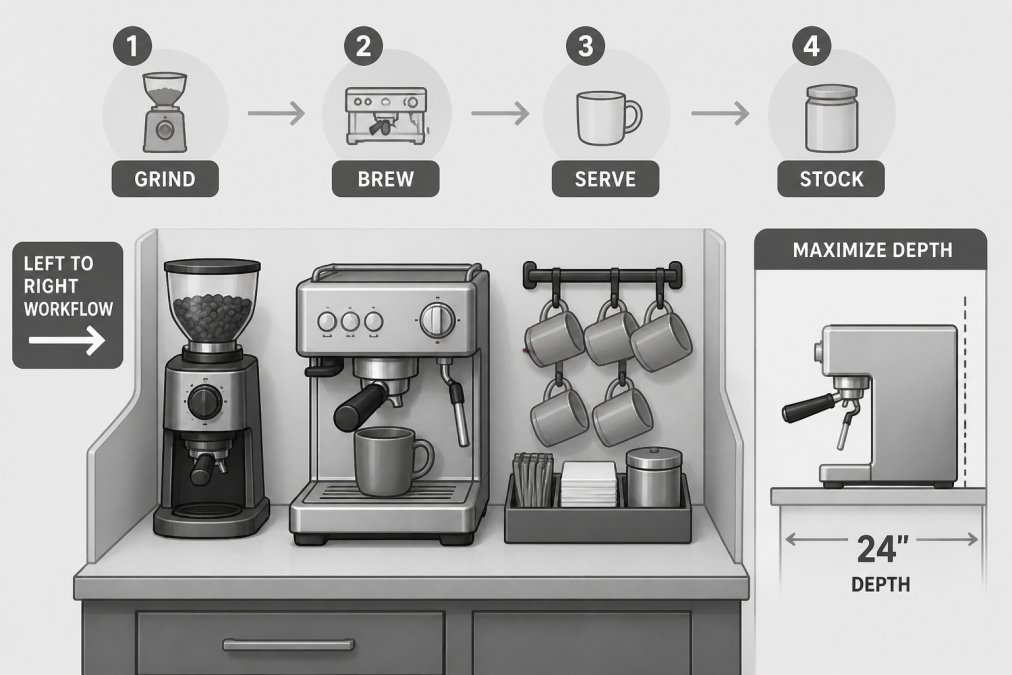
The 24-Inch Rule: Standard US kitchen counters are 24 inches deep (nkba.org). Before you buy any riser, pod carousel, or shelf, measure that depth. A common pattern is buying a two-tier riser that fits, but then placing a drip tray or scale in front of it that overhangs the edge by two inches. That overhang becomes a magnet for spills and a hazard for your knees. Keep a 2-inch clearance at the front edge of the counter for cleaning and to avoid items being knocked off.
Zone 1: Prep (Left Side) This zone holds your beans, grinder, and a small knock box if you use an espresso machine. The key is to keep the grinder's output chute aligned with the machine's portafilter. If you have to pivot or walk between grinding and locking in the portafilter, you're adding friction. A small, non-slip mat under the grinder absorbs vibration and prevents it from walking across the counter.
Zone 2: Brew (Center) The machine is the anchor. It needs 2-3 inches of clearance on each side for ventilation, and the water tank must be accessible. If your machine has a rear-mounted tank, you cannot push it flush against a backsplash without making refills a contortion act. Measure the tank access, if it's on the side, you need that side clear. If it's on top, you need vertical clearance to lift it out.
Zone 3: Serve (Right Side) This is where your daily mug lives, along with your milk pitcher or creamer. A small, wall-mounted mug hook or a magnetic strip for steel mugs keeps this zone clear. If you use a milk frother, it should sit here, not next to the grinder, so you're not reaching across the hot machine.
The Drawer Layer Drawer systems earn their keep here. A modular insert inside a cabinet keeps coffee pods, filters, and spare parts visible without eating counter space. For pod drinkers, a vertical coffee pod organizer holds a surprising number of capsules in a footprint no bigger than a toaster. But the real trick is to dedicate the top drawer directly below the machine to your brewing accessories. This creates a pull-out prep station that keeps the counter clear while you work.
A common mistake is grouping everything by type rather than by workflow. Store your beans next to the grinder, the grinder next to the machine, and your daily mug directly above the drip tray. That sequence mirrors how you brew, so your hands move in one direction instead of hunting across the kitchen.
DIY Coffee Bar Cart Ideas for Flexible, Rental-Friendly Setups
For renters or anyone who dislikes permanent changes, a rolling cart is the most practical answer. A three-tier cart gives you a dedicated coffee corner that tucks into a closet or corner when guests visit, and it moves with you to your next apartment.
The budget-friendly option is a basic three-tier utility cart with lockable casters. The top tier holds your machine, the middle stores mugs and beans, and the bottom handles backup supplies. Lock the front wheels so the cart doesn't roll away when you pull a shot.
If you want something that doubles as furniture, a mid-century bar cart with solid wood and metal construction adds style while keeping the same mobility. The tradeoff is price, but the build quality supports daily use for years.
The DIY angle comes from customization. Swap the standard wire shelves for wooden boards cut to size, add a towel bar to the side for hanging a rag, or attach small hooks underneath a shelf for demitasse spoons. These touches make a $35 cart feel like a built-in nook.
Vertical Storage and Wall Shelves: Use the Space You Overlook
Wall space above your counter is prime real estate that most small kitchens waste. Floating shelves turn that dead zone into a display area for mugs, canisters, and your coffee accessories, freeing up the counter below for actual brewing.
A wall-mounted shelf system works best when it follows a simple rule: keep heavy items low and light items high. Reserve the top shelf for mugs you use daily and decorative pieces. Store coffee beans in sealed canisters on a middle shelf where they're visible but out of direct sunlight, which degrades freshness.
For a rental, no-drill adhesive hooks and tension rods offer a damage-free path. A sturdy adhesive mug hook holds a ceramic cup easily, and a slim tension rod between two cabinet walls can hang a row of mugs. These solutions support the same visual effect as floating shelves without the patch-and-paint hassle later.
National Coffee Association brewing guidelines emphasize that proper bean storage means keeping coffee in an airtight container away from heat, light, and moisture, which makes a shaded wall shelf a smarter choice than a sunny windowsill.
Styling Your Coffee Corner: Decor That Keeps Counter Clutter Down
The best coffee bar decor does double duty: it looks intentional while solving a storage problem. A single wooden tray corrals the machine, grinder, and canisters into one visual unit, which instantly reads as designed rather than scattered.
Choose a small tray with a low lip so it contains spills without blocking access to your machine's water tank. On the tray, group items by height: tallest at the back, shortest in front. This layered arrangement looks polished even when everything is in daily use.
Aesthetic decor for a small coffee corner should follow the one-in-one-out rule. If you add a syrup dispenser, something else leaves the counter. The goal is a functional design that supports your morning routine, not a display case that gathers dust.
A compact coffee station also benefits from a dedicated mug rail or small mug tree mounted on the wall beside the machine. This keeps your daily cup within reach while adding a vertical accent that draws the eye upward, making the corner feel larger than it is.
Common Small-Space Coffee Bar Mistakes to Avoid
The most frequent error is choosing furniture before measuring your actual workflow. A beautiful console table that leaves no room for the machine's steam wand to vent, or a cart that blocks a cabinet door, becomes a daily frustration rather than a morning pleasure.
But the second, and often more damaging, mistake is ignoring the electrical reality of your space. Small kitchens rarely have a surplus of outlets, and coffee gear is power-hungry. An espresso machine can draw 1,200-1,500 watts during warm-up, and a grinder adds another 150-300 watts. Plugging both into a single outlet strip is a recipe for a tripped breaker.
The Outlet Audit Before you buy anything, map your available circuits. In most US homes built after 1987, kitchen counter outlets are on dedicated 20-amp circuits (nec.org). That means you can run roughly 1,900 watts continuously before tripping the breaker. A typical setup, espresso machine (1,400W) and grinder (200W), fits, but only if nothing else is on that circuit. If your coffee bar shares a circuit with a microwave or toaster, you will trip the breaker mid-shot.
Cable Management That Works A tangle of cords ruins both the look and the safety of your setup. The solution starts with a power strip that has a flat plug that sits flush against the wall. This prevents the plug from pushing the furniture away from the wall. Then, secure cords along the back edge of your counter or cart with adhesive clips. These clips cost under $10 for a pack of 20 and are rental-friendly, they peel off without residue.
For a rolling cart, the challenge is different. You need a power solution that moves with the cart. A short, heavy-duty extension cord rated for 15 amps can be routed along the underside of the cart frame using zip ties. This keeps the cord out of sight and prevents it from snagging on wheels. Never use a light-duty indoor cord for an espresso machine; the gauge is too thin and can overheat.
The Hidden Outlet Problem Many small spaces have outlets behind the counter but not above it. If your coffee bar is against a wall with a backsplash, you may have to run a cord up and over. A cord channel, a plastic raceway that sticks to the wall, can hide this run cleanly. It's paintable to match your wall and is a no-drill solution that renters can remove at move-out.
Ergonomics: The Third Mistake A third issue is ignoring the ergonomics of the space. If the machine sits too high or too low, you'll hunch or strain every time you brew. Standard counter height (36 inches) works for most people, but on a bar cart, check that the top tier puts the portafilter at a comfortable working level. A good rule of thumb: your elbow should be at a 90-degree angle when your hand is on the portafilter. If you're reaching up or bending down, adjust the cart's shelf height or place a sturdy cutting board under the machine to raise it an inch or two.
The Maintenance Trap Finally, small spaces get cluttered quickly because there's no room for error. A coffee bar that isn't cleaned daily will look chaotic by day three. Build a two-minute reset into your routine: wipe the drip tray, empty the knock box, and return the beans to their airtight container. This prevents the buildup of coffee oils and grounds that attract pests and makes the space feel manageable. A small, dedicated cleaning brush and a microfiber cloth stored in the drawer below the machine make this reset effortless.
Build Your Home Cafe: Final Thoughts on Small-Space Coffee Bars
The best small-space coffee bar ideas balance three priorities: a logical workflow, smart vertical storage, and honest editing of your gear. Start with the essentials checklist, choose a cart or shelf system that fits your rental situation, and let the decor emerge from what you actually use daily.
A dedicated coffee corner transforms the morning, but the beans matter just as much as the setup. USM Coffee roasts every batch to order from carefully sourced beans, so your compact station delivers maximum flavor and aroma in every cup. Our simple ordering process and fast, reliable delivery mean your counter never runs dry.
Get started with USM Coffee and turn that corner of your kitchen into a home cafe worth waking up for.
Frequently Asked Questions
What are some DIY ideas for a small coffee bar?
A rolling utility cart is one of the easiest DIY coffee bar ideas for small spaces. Look for a three-tier cart with lockable wheels, then add a wooden cutting board on top for a stable espresso machine surface. Use the lower shelves for mugs, coffee pods, and syrups. For a no-drill option, hang an over-the-door organizer or use a slim rolling cart that fits between your counter and refrigerator.
What are some ideas for a coffee bar on a small kitchen counter?
To build a coffee station on a small counter, start with a tray to define the zone and catch spills. Choose a compact espresso machine or pour-over kettle rather than a bulky drip brewer. Store mugs on a mug tree or wall hooks to free up counter space. Use vertical canisters for beans and a small pod organizer to keep everything within arm's reach without creating counter clutter.
How do you organize a coffee station in a small kitchen?
Small coffee station organization starts with grouping items by frequency of use. Keep your machine, daily beans, and favorite mug on the counter. Store backup supplies, like extra pods and syrups, in a cabinet or drawer with dividers. Use vertical space with floating shelves or a wall-mounted rail for mugs. A slim cart can hold overflow items and tuck away when not in use.
What should I include in a small home coffee bar setup?
A functional small coffee bar setup needs only the essentials: your brewing method, fresh coffee beans, a grinder if you use whole beans, mugs, and a water source. A coffee bar essentials checklist should also include storage for pods or syrups, a tray or mat to protect your counter, and a small trash bin for used grounds. Skip single-use gadgets that take up valuable space.
How can I make a coffee bar without drilling holes in my wall?
Rental-friendly coffee bar ideas include using freestanding furniture like a utility cart, a slim console table, or a microwave cart. For vertical storage without drilling, try command hooks for lightweight mugs, a tension rod between cabinets for hanging items, or an over-the-door shoe organizer for coffee supplies. These options let you create a dedicated coffee corner and remove it easily when you move.