

Fresh Roasted Coffee vs Store-Bought: 2026 Comparison
Table of Contents
- Fresh Roasted Coffee vs Store-Bought: A Side-by-Side Comparison
- The Science of Coffee Freshness: Oxidation and Degassing
- Coffee Roast Date Importance: Why the Calendar Matters
- Signs of Stale Coffee Beans: How to Spot Flavor Degradation
- How to Keep Coffee Beans Fresh Longer: Storage and Packaging
- Flavor, Aroma, and Body: What You Actually Taste
- Making the Choice: Fresh Roasted vs Store-Bought for Your Routine
- Frequently Asked Questions
Last Updated: September 14, 2026
Fresh Roasted Coffee vs Store-Bought: A Side-by-Side Comparison
Fresh roasted coffee is coffee that a roaster packages within days of roasting, rather than months before it reaches a shelf. That single timing difference drives nearly every gap between fresh roasted coffee vs store-bought beans: aroma, flavor, crema, and how long the coffee stays worth drinking. This guide from USM Coffee breaks down what actually changes after roasting, so you can decide which option fits your counter, your budget, and your morning routine.
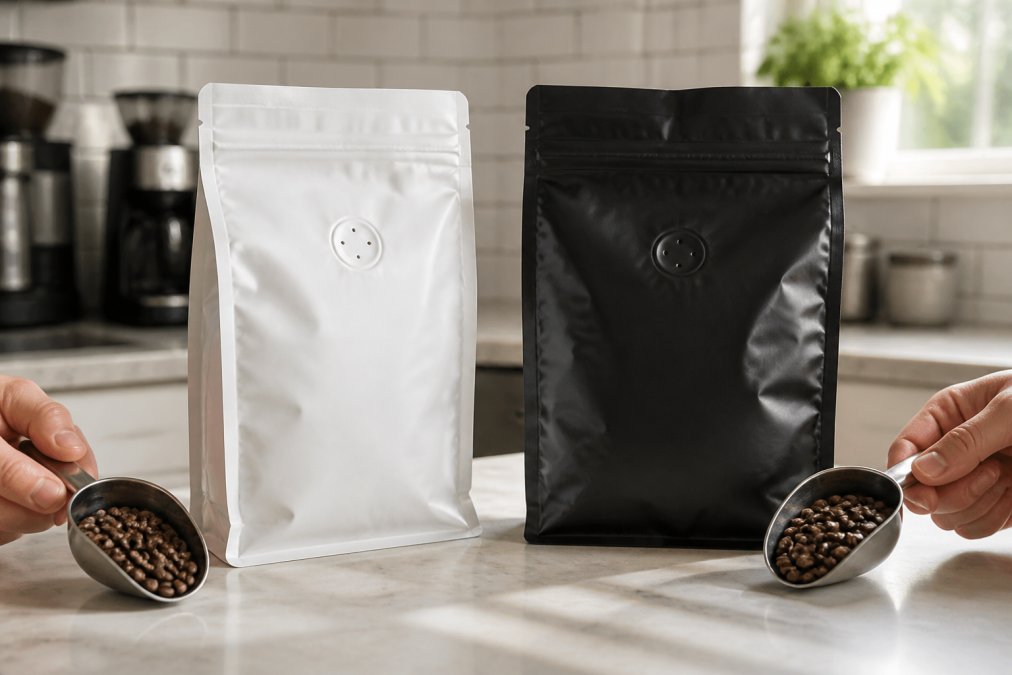
Comparison Table: Key Differences at a Glance
| Factor | Fresh Roasted Coffee | Store-Bought Coffee |
|---|---|---|
| Time since roasting | Days to a few weeks | Often months |
| Packaging | One-way valve, sometimes nitrogen-flushed | Often vacuum-sealed or standard sealed bag |
| Aroma at opening | Strong, layered | Muted or flat |
| Peak window | Narrow, roughly 4-12 weeks | Wide but declining from day one |
| Cost per ounce | Higher | Lower |
| Best for | Flavor-focused daily drinkers | Convenience and budget |
The Science of Coffee Freshness: Oxidation and Degassing
Two processes decide how coffee tastes over time: degassing and oxidation. Right after roasting, beans release carbon dioxide trapped during the roast (pubmed.ncbi.nlm.nih.gov). Over the following days and weeks, oxygen slowly reacts with the oils and volatile compounds inside the bean, and that reaction is what flattens aroma and turns flavors dull or papery.
Why Carbon Dioxide Matters for Your Brew
Carbon dioxide is not a flaw, it is a stage. Fresh beans off-gas CO2 for days, and that gas interferes with even water contact during brewing. This is why a bag roasted yesterday can actually brew worse than one roasted ten days ago.
The Specialty Coffee Association's guidance on coffee freshness notes that most beans reach a practical brewing window after the initial rush of CO2 subsides. Too fresh and your pour-over stalls; too old and the CO2 is gone along with the aromatics.
Coffee Roast Date Importance: Why the Calendar Matters
A roast date is the single most useful number on any coffee bag, and it matters more than a best-by date. Best-by dates are chosen by the seller and often sit months out. A roast date tells you exactly how long the beans have been losing aroma, and it is the only number that lets you plan around the degassing curve instead of guessing.
Store-bought bags rarely carry a roast date at all. When they do, it is often a 'packed on' or 'best by' stamp that says nothing about when the beans actually met the heat. That is the core problem: without a roast date, you cannot tell whether you are buying coffee at its peak or coffee that peaked before it was shipped.
The Resting Period: When to Brew After Roasting
The resting period is the window between roasting and brewing when beans are still degassing too aggressively to brew well. This is the nuance most buying guides skip, and it is the reason 'fresher' is not automatically 'better' on day one.
A useful way to think about the timeline:
- Days 0-2: Very fresh. CO2 release is heavy, and brewed coffee can taste sharp, gassy, or underdeveloped. Espresso in particular may pour erratically.
- Days 3-10: The typical filter sweet spot. Degassing has slowed enough for even water contact, and the volatile aromatics are still largely intact.
- Days 7-14: The typical espresso sweet spot. Pressurized brewing is more sensitive to trapped gas, so espresso often needs a longer rest than pour-over or drip.
- Weeks 2-6: Still good for most brew methods, with aroma beginning a gradual decline.
- Beyond roughly 6 weeks: Flavor flattens noticeably for most beans, though darker roasts and certain origins hold up a little longer.
A bag roasted two days ago and a bag roasted two weeks ago can both be excellent, just at different points on the curve. The practical move is to buy coffee that arrives within a few days of roasting, then let it rest to your preferred window rather than brewing it the moment it lands.
Reading a Roast Date Like a Buyer
When you pick up a bag, the roast date tells you three things at once: how much resting time is left, how much peak window remains, and whether the seller is confident enough in turnover to print it. A roaster who stamps the date is usually a roaster who expects the bag to sell quickly.
This is where roast-to-order models have a structural advantage. Coffee roasted after you order arrives near the start of its curve, so you control the resting period instead of inheriting whatever is left of it.
Signs of Stale Coffee Beans: How to Spot Flavor Degradation
Stale coffee announces itself in a few reliable ways. The most obvious signs of stale coffee beans are a flat, cardboard-like smell when you open the bag, beans that look dry and matte rather than slightly oily, and a brew that tastes hollow or bitter without any sweetness underneath.
A few quick checks:
- Smell the bag the moment you open it. Weak or dusty aroma means the volatile compounds are mostly gone.
- Look at the beans. A dull, faded surface suggests oxidation has set in.
- Check for a roast date. No date at all is usually a sign the coffee was never meant to be tracked for freshness.
- Brew a small cup and taste for sweetness. Fresh coffee has some; stale coffee mostly has bitterness and a dry finish.
How to Keep Coffee Beans Fresh Longer: Storage and Packaging
The best storage method is simple: keep beans whole, keep them sealed, and keep them away from air, light, heat, and moisture. Whole beans hold their volatile compounds far longer than ground coffee because there is less surface area exposed to oxygen. Grinding multiplies that surface area many times over, which is why pre-ground coffee stales dramatically faster than whole bean.
Store beans in an opaque, airtight container at room temperature, not in the fridge (Effect of Temperature and Storage on Coffee’s Volatile Compound Profile and Sensory...). The refrigerator introduces moisture and odors that coffee absorbs readily, and the repeated temperature swings every time you open the door push condensation onto the beans. The freezer works for longer-term storage if you portion beans into sealed bags and let them come to room temperature before grinding, so moisture does not condense on the beans as they thaw.
Packaging Technology: Why Some Bags Last Longer Than Others
Packaging does more freshness work than most buyers realize, and the differences between bag types explain why two store-bought coffees with similar shelf lives can taste very different when opened.
- One-way valve bags: A small valve lets CO2 escape without letting oxygen in. This is why a good bag does not balloon and burst during degassing, and why it does not go flat either. The valve is a freshness feature, not a gimmick.
- Nitrogen-flushed bags: The air inside is replaced with inert nitrogen before sealing, which slows oxidation before the coffee ever reaches you. This is common in larger commercial operations and is one reason a well-packaged store-bought bag can hold up better than its roast date suggests.
- Vacuum-sealed bags: Removing air reduces oxygen contact, but the tight compression can press oils to the surface and, once opened, the coffee is fully exposed to air with no valve to manage ongoing degassing.
- Standard sealed bags: No valve, no gas flush. CO2 has nowhere to go, so the bag either puffs up or the roaster has to let the coffee rest before packing it, which eats into your window.
The key insight is that packaging is engineered around a goal. A bag built for a long shelf life is optimized for stability, while a bag built for peak flavor is optimized for a short, well-tracked window. Those two goals pull in opposite directions, and the packaging tells you which one the seller chose.
Storage Trade-Offs That Actually Matter
No container beats the roast date. The best storage setup in the world cannot restore aromatics that oxidation already took. What good storage does is slow the decline between the day you open the bag and the day you finish it.
The practical hierarchy, from most to least impactful:
- Buy coffee with a recent roast date.
- Keep beans whole until you brew.
- Use an opaque, airtight container with minimal headspace.
- Store at room temperature, away from the stove and the window.
- Freeze only for long-term storage, in sealed portions.
Follow those in order and you will get more out of a bag than any single gadget can deliver.
Flavor, Aroma, and Body: What You Actually Taste
Fresh coffee tastes sweeter, brighter, and more layered because its volatile compounds are still intact. Those compounds carry the fruity, floral, chocolate, and nut notes that define a bean's flavor profile. Once they oxidize, you are mostly left with bitterness and a thin body.
Acidity is the clearest tell. In fresh coffee, acidity reads as brightness, that lively snap on the front of your tongue. In stale coffee, the same beans taste flat or sour in an unpleasant way. Aroma follows the same curve, which is why coffee smells best in the first minute after grinding.
What matters most is that this holds up in a regular drip machine, not just a pour-over setup. Fresh beans improve any brewing method because the flavor was there to extract in the first place. Grind size and brewing method change how much you pull out, but they cannot put back what oxidation already took.
Making the Choice: Fresh Roasted vs Store-Bought for Your Routine
The honest answer is that store-bought coffee wins on convenience and cost, and fresh roasted coffee wins on everything you taste. If you drink coffee mainly for caffeine and rarely notice aroma, the grocery aisle is fine. If you actually enjoy the cup, the freshness gap is the biggest upgrade available to you, bigger than a new grinder or a new brewer.
For most people, the practical middle ground is a roast-to-order subscription that ships on a schedule matching how much you drink. That solves the two real objections: stale beans and bags piling up faster than you can brew them. At USM Coffee, every batch is roasted to order and shipped fast. You can pause or adjust your cadence anytime, which keeps you from paying for coffee you will not finish.
A quick way to decide:
- Choose store-bought if: you want the lowest cost per ounce and do not mind muted flavor.
- Choose fresh roasted if: aroma, sweetness, and body matter to you.
- Choose a subscription if: you want freshness without remembering to reorder.
Frequently Asked Questions
Why is fresh roasted coffee better than store-bought?
Fresh roasted coffee retains more volatile compounds that create aroma and flavor. Once beans are roasted, oxidation and degassing begin. Store-bought coffee often sits on shelves for months, losing peak freshness. Fresh roasted coffee, especially when roasted to order, delivers brighter acidity, fuller body, and more complex flavor notes. The difference is most noticeable in the first two to four weeks after the roast date.
How long should you wait to drink freshly roasted coffee?
Most roasters recommend waiting 3 to 7 days after the roast date before brewing. This resting period allows carbon dioxide to escape, preventing uneven extraction. For espresso, some baristas prefer 7 to 14 days. For drip or pour-over, 3 to 5 days often works well. If you brew immediately, you may notice a sharp or gassy taste. After the rest, flavor peaks and remains stable for about two weeks.
What are the signs of stale coffee beans?
Signs of stale coffee beans include a dull, flat aroma, a cardboard or papery smell, and a lack of crema when brewing espresso. The beans may look oily or dry, and the flavor turns bitter or sour without complexity. If your coffee tastes hollow or lifeless, it is likely past its peak. Check the roast date; if it has been more than four to six weeks, freshness has declined significantly.
How can I keep coffee beans fresh longer at home?
To keep coffee beans fresh longer, store them in an airtight container away from light, heat, and moisture. A vacuum-sealed canister or a bag with a one-way valve works well. Keep beans whole and grind just before brewing. Avoid the refrigerator due to moisture and odors; the freezer can work for long-term storage if beans are sealed in airtight portions. Buy only what you will use within two to four weeks.
Does store-bought coffee go bad?
Yes, store-bought coffee goes bad over time. While it may not spoil in a food-safety sense, it loses flavor and aroma. Most grocery store coffee has a best-by date, not a roast date, so you cannot know how long it has sat. Once opened, oxidation accelerates. For the best taste, use store-bought coffee within one to two weeks of opening, and check for stale signs like flat aroma or cardboard flavor.
The real challenge with fresh roasted coffee is not finding it, it is keeping it at its peak once it arrives. USM Coffee roasts every batch to order, ships it fast to your door, and offers a simple ordering process you can adjust as your habits change, so you get maximum flavor and freshness without waste. Explore the current lineup and let your next bag carry a roast date worth reading.