

How to Keep Coffee Beans Fresh Longer: 7 Proven Steps
Table of Contents
- What Destroys Coffee Beans Fresh From the Roaster
- How Long Do Coffee Beans Stay Fresh After Roasting
- Does Coffee Go Bad? Signs Your Beans Are Past Their Prime
- Best Coffee Storage Containers: What the Material Actually Does
- Step-by-Step: How to Keep Coffee Beans Fresh Longer at Home
- Freezing Coffee Beans: The Right Way to Do It
- Altitude, Humidity, and Grind Timing: The Variables Most Guides Skip
- Common Mistakes That Kill Freshness Faster Than You Expect
Last Updated: August 2, 2026
Knowing how to keep coffee beans fresh longer is the difference between a cup that sings and one that tastes like cardboard. At USM Coffee, we roast every batch to order precisely because freshness isn't a marketing claim, it's the entire point. Most guides tell you to "store in a cool, dark place" and call it done. That advice isn't wrong, but it skips the variables that actually determine whether your beans last 10 days or 30. Below, we'll walk through exactly what destroys freshness, which containers actually work, and the storage protocols that most home brewers never bother with.
Degassing is real, and ignoring it costs you flavor. Freshly roasted coffee releases carbon dioxide for days after roasting. Brew too early and that CO₂ interferes with extraction. Wait too long and oxidation takes over. The window between those two extremes is where great coffee lives.
What Destroys Coffee Beans Fresh From the Roaster
The four enemies of fresh coffee beans are oxygen, moisture, heat, and light. Understanding how each one works changes the way you store beans permanently.
Oxidation and Carbon Dioxide: The Degassing Window
Oxidation is the chemical process by which oxygen breaks down the volatile compounds responsible for aroma and flavor in roasted coffee. Once a bean is roasted, it becomes porous and begins releasing carbon dioxide in a process called degassing. This CO₂ acts as a temporary protective barrier, pushing oxygen away from the bean's surface. According to the Specialty Coffee Association's resources on post-roast chemistry, this degassing phase typically peaks within the first 24-72 hours after roasting and continues at a slower rate for days afterward.
The practical implication: whole beans roasted within the past week should rest for at least 24 hours before brewing espresso. For pour-over or drip, 3-5 days post-roast is often ideal. Grind too early in the degassing window and you'll notice excessive bloom and flat flavor. Wait past the freshness window and rancidity sets in as oxygen wins.
How Moisture, Heat, and UV Exposure Speed Up Flavor Degradation
Moisture accelerates staling faster than almost any other variable. Water molecules react with the soluble compounds in roasted coffee, breaking down acids and sugars that define the bean's aroma profile. Even ambient humidity above 60% can noticeably degrade coffee within a week.
Heat drives the same chemical reactions but faster. Every 10°F increase in storage temperature roughly doubles the rate of flavor degradation. Direct sunlight compounds the problem by delivering both UV exposure and heat simultaneously. Keep beans away from the stove, the windowsill, and any surface that warms up during the day.
How Long Do Coffee Beans Stay Fresh After Roasting
Whole coffee beans stay meaningfully fresh for 2-4 weeks after their roast date when stored correctly in an airtight, opaque container at room temperature. Pre-ground coffee has a much shorter freshness window, typically 1-2 weeks, because grinding dramatically increases surface area exposed to oxygen.
How Roast Level Changes the Freshness Window
Roast level is one of the most overlooked variables in coffee storage, and it matters more than most people realize.
Light roasts retain more moisture and density than dark roasts, which means they degas more slowly and tend to hold their flavor compounds longer. A well-stored light roast can remain vibrant for up to 4 weeks post-roast. Dark roasts have been roasted to the point where oils migrate to the bean's surface, making them highly susceptible to oxidation and rancidity. A dark roast stored under identical conditions will typically stale noticeably faster, often within 1-2 weeks of peak flavor. Medium roasts fall in between, with a freshness window of roughly 2-3 weeks.
| Roast Level | Peak Freshness Window | Surface Oil Exposure | Degassing Speed |
|---|---|---|---|
| Light | 3-4 weeks post-roast | Low | Slow |
| Medium | 2-3 weeks post-roast | Moderate | Moderate |
| Dark | 1-2 weeks post-roast | High | Fast |
Does Coffee Go Bad? Signs Your Beans Are Past Their Prime
Yes, coffee goes bad, though it won't make you sick the way spoiled meat does. Stale coffee is a quality problem, not a safety problem.
Smell the beans first. Fresh coffee beans have a sharp, complex aroma that's immediately recognizable. Stale beans smell flat, papery, or faintly rancid.
Check the surface of dark roasts. Some surface sheen is normal on fresh dark roasts; a greasy, wet appearance on older beans signals oxidation.
Look for color fading. Fresh beans have a consistent, rich color. Beans exposed to air and humidity often develop a dull, uneven appearance.
Taste the brewed cup. Stale coffee tastes one-dimensional, often bitter without complexity or sour without brightness.
Best Coffee Storage Containers: What the Material Actually Does
The container you choose determines how much oxygen, moisture, and light reach your beans between brews.
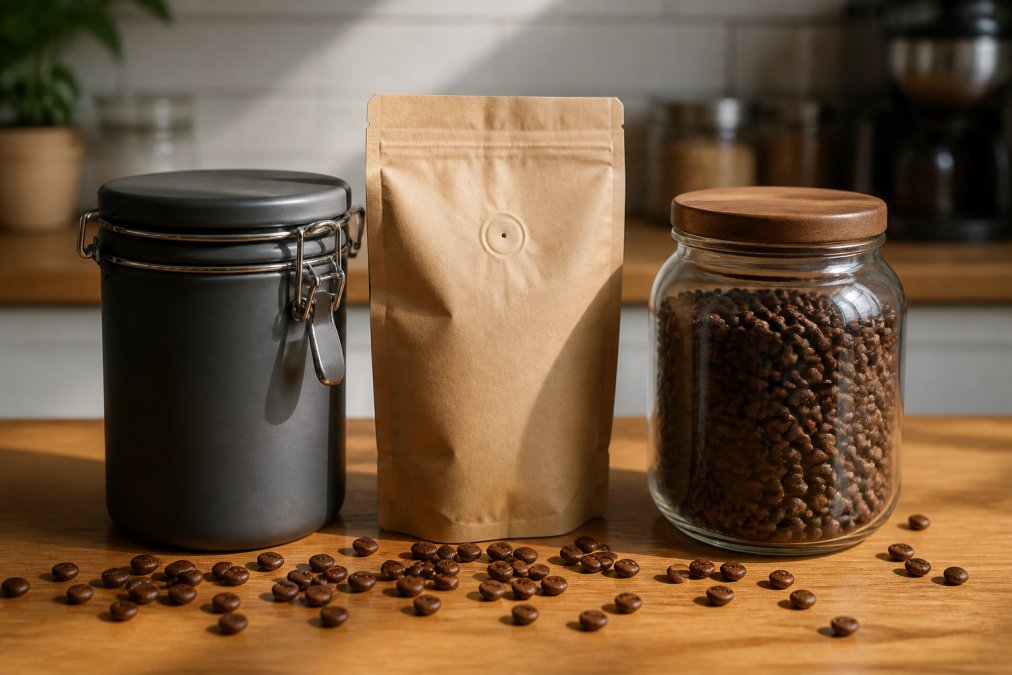
Ceramic and stainless steel canisters with airtight seals are the strongest performers for home storage. Both materials are non-porous, meaning they don't absorb coffee oils or odors over time. Ceramic provides natural insulation against temperature fluctuations. Stainless steel is durable and blocks UV exposure completely. Plastic containers are porous at a molecular level and can leach odors into the beans over time. Glass is UV-transparent unless tinted, making it a poor choice unless stored inside a cabinet.
One-Way Valve Bags vs. Airtight Canisters
One-way valve bags are the packaging format most specialty roasters use. The valve allows CO₂ from degassing beans to escape without letting outside oxygen in. This is the correct solution for the first week after roasting, when degassing is most active.
Once you open the bag, the seal degrades with each use. For beans you'll consume within a week of opening, keeping them in the original valve bag with the top rolled tight is fine. For longer storage, transfer to an airtight canister after the initial degassing period. Vacuum-seal canisters actively remove oxygen from the container and are worth the investment for home brewers who buy in larger quantities.
Opaque vs. Clear: Why UV Exposure Matters More Than You Think
Clear glass and transparent plastic containers look attractive on a countertop, but UV exposure degrades the volatile compounds in roasted coffee even through indirect light. An opaque canister stored on an open shelf outperforms a clear glass jar stored inside a dark cabinet because the opaque material provides a second layer of protection against light scatter.
If light can reach the beans, choose a different container or storage location.
Step-by-Step: How to Keep Coffee Beans Fresh Longer at Home
This is the core protocol. Follow these steps in order and you'll extend your beans' freshness window significantly.
Total Time: 10 minutes to set up, ongoing
- Check the roast date before buying. Aim for beans roasted within the past 2 weeks. If no roast date is listed, that's a red flag.
- Let fresh beans rest. For espresso, rest 24-72 hours post-roast before brewing. For filter coffee, 3-5 days is ideal.
- Transfer to an opaque, airtight container. After the initial degassing period, move beans from the valve bag to a ceramic or stainless steel canister with a locking seal.
- Store in a cool, dry location. A pantry shelf away from the stove and away from direct sunlight is ideal. Target ambient temperatures below 70°F.
- Grind immediately before brewing. Pre-ground coffee loses most of its volatile compounds within 15-30 minutes of grinding. A burr grinder set to your brewing method's grind size makes a measurable difference in cup quality.
- Buy in quantities you'll finish within 2-3 weeks. Smaller, more frequent purchases beat bulk buying every time.
- Never return unused ground coffee to the bean container. Ground coffee accelerates staling in whole beans through cross-contamination of fine particles.
Freezing Coffee Beans: The Right Way to Do It
Freezing coffee beans is genuinely effective when done correctly. The problem is that most people do it wrong.
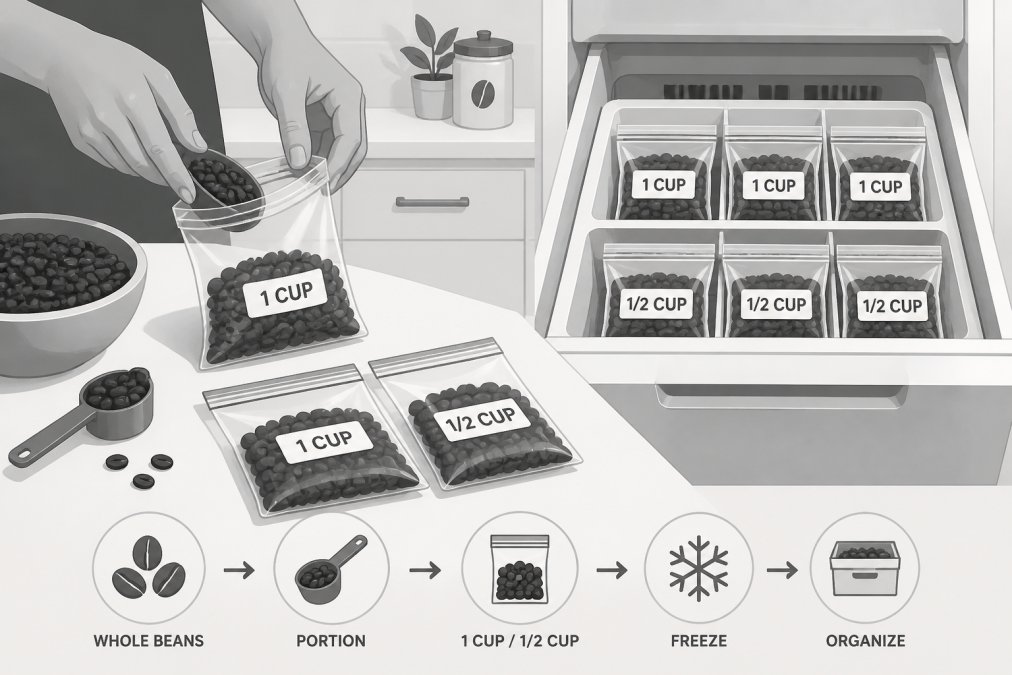
The core principle: freeze in single-use portions. Repeated freeze-thaw cycles cause condensation to form on the beans, and that moisture accelerates staling faster than room-temperature storage would. As documented in food science research on freeze-thaw cycles and volatile compound retention, controlled freezing can preserve aromatic compounds effectively when moisture exposure is minimized.
Here's the correct method:
- Divide your beans into portions that match one or two brewing sessions (typically 20-40 grams per session).
- Seal each portion in a small, airtight freezer bag, removing as much air as possible before sealing. Vacuum-seal bags are ideal.
- Place all portions in a single larger airtight container before putting them in the freezer.
- Label each portion with the roast date.
- Freeze only beans you don't plan to use within the next 2-3 weeks.
Post-Thaw Protocol: What to Do After Beans Leave the Freezer
Frozen beans must never go back into the freezer once thawed. The condensation that forms as beans return to room temperature is the primary cause of accelerated staling in improperly frozen coffee.
The correct post-thaw protocol:
- Remove only the portion you need for that brewing session.
- Leave the sealed bag on the counter and let it reach room temperature before opening, typically 15-20 minutes.
- Grind and brew immediately after the bag reaches room temperature.
- Discard any thawed beans you don't use within 24 hours rather than refreezing.
Altitude, Humidity, and Grind Timing: The Variables Most Guides Skip
Most storage guides assume you're brewing at sea level in a climate-controlled home. If you're not, the standard advice needs adjustment.
Humidity. High-humidity environments accelerate moisture absorption in stored beans dramatically. If your home regularly exceeds 65% relative humidity, standard pantry storage is insufficient. An airtight container with a food-safe silica gel desiccant pack adds meaningful protection. According to USDA guidelines on food storage and moisture control, moisture is the primary accelerant of oxidative degradation in shelf-stable food products, and coffee is no exception.
Altitude. At higher elevations, water boils at lower temperatures and air pressure is reduced. Lower air pressure means the CO₂ in freshly roasted beans degasses slightly faster, shortening the optimal rest window. Brewers in Denver or Albuquerque may find their beans peak a day earlier than the standard guidance suggests.
Grind timing. Pre-ground coffee is a freshness compromise that many home brewers accept without realizing how significant it is. The surface area of ground coffee is exponentially larger than whole beans, meaning oxidation happens orders of magnitude faster. Grinding 30 minutes before brewing versus grinding immediately before produces a noticeably different cup. A quality burr grinder is the single highest-impact equipment upgrade for home coffee freshness.
Common Mistakes That Kill Freshness Faster Than You Expect
The refrigerator is not a storage solution. Refrigerators cycle moisture constantly, and coffee beans absorb odors from surrounding food with remarkable efficiency. Your beans will taste like last night's leftovers within days.
Buying pre-ground in bulk is another major error. Ground coffee has a freshness window measured in days, not weeks. Buying a large bag to save money is a false economy.
Storing beans on top of the espresso machine creates repeated temperature fluctuations that accelerate staling. The machine radiates heat during use and cools down afterward, harming your coffee.
Finally, ignoring the roast date makes all other storage efforts irrelevant. The best container in the world can't rescue beans that were already two months past their roast date when you bought them. Freshness starts at the source, which is why roast-to-order matters. USM Coffee roasts every batch after you order, so the clock on freshness starts when it should: when the beans are heading to you, not when they've been sitting in a warehouse.
Frequently Asked Questions
Should you store coffee beans in the freezer?
Freezing coffee beans works well only when done correctly. Portion beans into airtight, vacuum-sealed bags before freezing so you never refreeze a thawed batch. Condensation is the main risk: moisture from temperature fluctuations degrades the aroma profile fast. Once beans come out of the freezer, let them reach room temperature inside the sealed bag before opening. Used this way, freezing can extend a whole bean's freshness window from weeks to several months.
How long do coffee beans stay fresh after roasting?
Whole beans stay at peak flavor for roughly two to four weeks after the roast date when stored in a cool, dry place in an airtight container. Pre-ground coffee loses volatile compounds much faster and is noticeably stale within a week. Dark roasts have more porous cell structure and higher oil migration, so they degrade slightly faster than lighter roasts. Always check the roast date on the bag rather than a vague 'best by' date for an accurate freshness read.
Will a Ziploc bag keep coffee beans fresh?
A standard zip-lock bag is not an effective coffee storage container. It lacks an oxygen barrier, allows air exchange through the seal, and offers no UV protection. The result is accelerated oxidation and rancidity within days. For short-term storage of a day or two, it is acceptable in a pinch, but a proper airtight canister or a one-way valve bag with a nitrogen-flushed seal will protect your beans far better and preserve the full aroma profile.
Does light affect coffee bean freshness?
UV exposure is a direct cause of flavor degradation in coffee beans. Light triggers photochemical reactions that break down volatile compounds responsible for aroma and taste. Clear glass jars placed near a window can stale beans in days. An opaque canister or a dark, sealed bag stored away from direct sunlight blocks this entirely. If your container is not opaque, keep it inside a cabinet rather than on an open countertop to protect the freshness window.
How do I store coffee beans long term?
For long-term storage beyond a month, freezing is the most effective method when paired with the right protocol. Divide your supply into small, single-use portions in vacuum-sealed or airtight bags, removing as much air as possible. Label each bag with the roast date. Store in the back of the freezer where temperature is most stable. Never return thawed beans to the freezer. For everyday use within two to four weeks, an opaque airtight canister in a cool dry place is sufficient.
Is it better to buy whole beans or pre-ground for freshness?
Whole beans stay fresh significantly longer than pre-ground coffee. Grinding dramatically increases the surface area exposed to air, accelerating oxidation and the loss of volatile compounds that create aroma and flavor. Pre-ground coffee can go noticeably flat within three to five days of opening. Grinding whole beans immediately before each brewing cycle is the single most effective step for maximizing cup quality, regardless of how well the beans themselves were stored.
Keeping coffee beans fresh longer requires more than good intentions. The real challenge is managing oxygen, moisture, heat, and time simultaneously, across every step from purchase to grind. USM Coffee makes the first step straightforward: beans roasted to order from carefully sourced farms, delivered fast so the freshness window is entirely in your hands. Get started with USM Coffee and experience the difference that a genuine roast date makes in every cup you brew.