

How to Store Fresh Coffee Beans Properly
Table of Contents
- The Four Enemies of Coffee Freshness
- Why Your Original Bag Is Often Your Best Storage Option
- Choosing the Best Coffee Storage Canisters
- How Long Coffee Beans Stay Fresh After Roasting
- Freezing Coffee Beans: When and How to Do It Right
- Where to Store Coffee in Your Kitchen
- Long-Term Storage for Bulk Buying and Travel
- Conclusion
Last Updated: August 16, 2026
The Four Enemies of Coffee Freshness
The moment coffee beans are roasted, they begin to decline. Four environmental factors accelerate this deterioration: heat, light, moisture, and air exposure.
Heat causes volatile compounds to evaporate rapidly, stripping away nuanced flavors and degrading the oils that carry taste. Light, particularly direct sunlight and fluorescent bulbs, triggers photodegradation, breaking down flavor compounds. Moisture is equally destructive, beans are hygroscopic and absorb water from humid air, triggering chemical reactions that stale the coffee and promote mold growth. Finally, air exposure allows oxygen to oxidize the beans' oils and volatile compounds, which is why an open bag loses freshness faster than a sealed one.
At USM Coffee, we roast beans to order specifically because we understand how critical the first few weeks after roasting are. The good news: you can control all four enemies with straightforward storage choices.
Why Your Original Bag Is Often Your Best Storage Option
Most coffee enthusiasts assume they need a fancy storage container. In reality, the original bag from specialty roasters like USM Coffee is often superior.
Quality coffee bags feature one-way degassing valves that allow carbon dioxide (a roasting byproduct) to escape without letting oxygen back in. During the first week after roasting, beans release significant CO2. A sealed container without a valve would build pressure and potentially rupture. The one-way valve solves this while maintaining an oxygen barrier.
Professional roasters use multi-layer films with aluminum foil or metalized plastic that blocks light completely, far more opaque than most home storage containers. The bag is also designed to be folded and sealed after opening, minimizing air exposure between uses.
When you transfer beans to another container, you lose these engineered advantages and expose beans to air and light during transfer. Unless your storage container has a one-way valve and is truly opaque, the original bag likely performs better.
The practical approach: keep beans in their original bag, fold the top down tightly after each use, and store in a cool, dark place. If you must transfer beans, choose an airtight option with a one-way valve.
Choosing the Best Coffee Storage Canisters
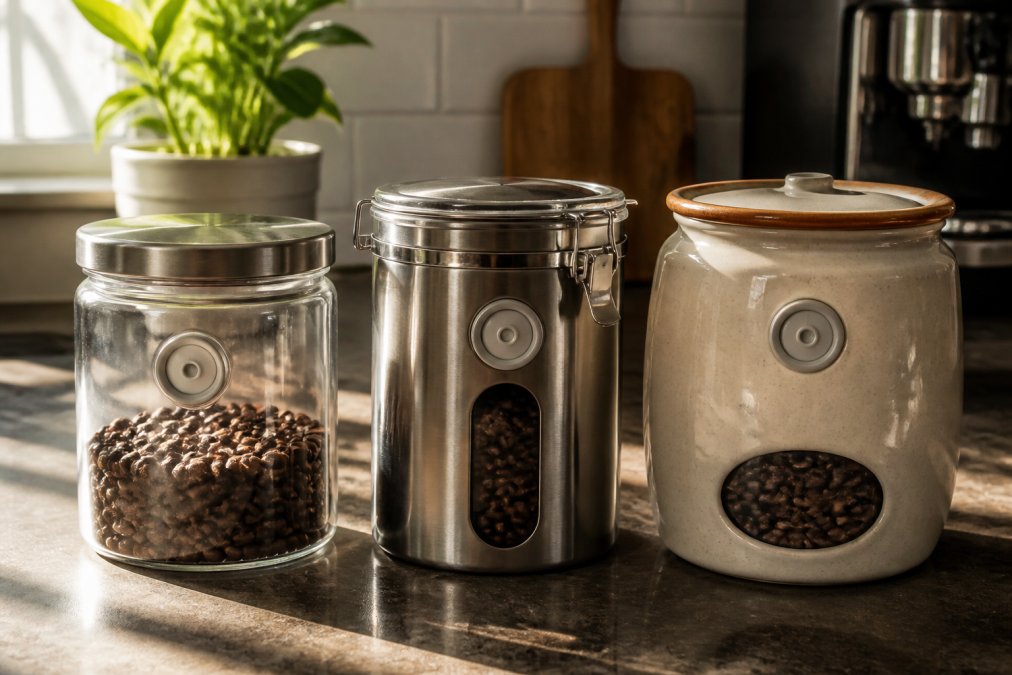
If you choose to store beans in a separate container, prioritize these features: an airtight seal, opacity, a one-way degassing valve, and appropriate size.
Airtight seal. The container must close tightly enough that air cannot enter. Screw-top lids work better than snap-fit lids because they create more consistent pressure.
Complete opacity. Glass containers look attractive but fail this requirement unless dark-tinted. Clear glass exposes beans to light every time you open the lid. Stainless steel and ceramic canisters block light completely.
One-way degassing valve. This feature is essential during the first two weeks after roasting when beans release the most CO2. A valve allows gas to escape without letting oxygen back in.
Appropriate size. A container that's too large leaves too much headspace, meaning more air oxidizes the coffee over time. Choose a container that holds roughly the amount of beans you'll use in one to two weeks.
Common options include stainless steel canisters with rubber seals (reliable and affordable), ceramic containers with airtight lids (attractive and effective), and specialized coffee canisters designed by coffee companies (often include one-way valves). The best coffee storage canisters balance functionality with durability, a mid-range stainless steel option with a one-way valve typically outperforms expensive designer containers.
How Long Coffee Beans Stay Fresh After Roasting
Peak flavor typically occurs between 5 and 30 days after roasting. During this window, beans have released most excess CO2 while retaining the volatile compounds that create complexity and aroma.
Before day 5, beans are still actively degassing and flavors are somewhat muted. After day 30, oxidation and staling noticeably degrade the cup. The beans don't become undrinkable, but nuance diminishes.
This timeline assumes proper storage. Beans kept in an open container or exposed to heat and light will stale much faster. Properly stored beans in an opaque, airtight container can maintain acceptable quality for 6-8 weeks.
The roast date matters more than the purchase date. When you buy from USM Coffee or any specialty roaster, the roast date is printed on the bag. This is the reference point for freshness, not the day it arrived at your door.
For the best experience, order only what you'll use within three to four weeks. If you buy larger quantities, store half the batch in a freezer and use the room-temperature portion within the peak window.
Freezing Coffee Beans: When and How to Do It Right
Freezing extends shelf life significantly, but only if done correctly. Freezing slows oxidation and staling dramatically, beans stored in the freezer can maintain reasonable quality for 3-6 months, compared to 6-8 weeks at room temperature.
The real enemy of frozen beans is condensation. When you remove a sealed container of frozen beans and open it, the temperature difference causes moisture to condense on the beans' surface. This moisture triggers the same degradation processes that humidity causes at room temperature.
The correct approach for freezing coffee beans:
-
Freeze in small portions. Divide beans into amounts you'll use within one to two weeks so you only thaw what you need.
-
Use airtight, opaque containers. Transfer beans to small airtight containers or resealable bags, removing as much air as possible. Vacuum-seal bags work exceptionally well.
-
Keep frozen beans sealed until use. Do not open the container until you're ready to grind and brew.
-
Thaw at room temperature. Let the sealed container sit at room temperature for 30-60 minutes before opening to minimize condensation.
-
Grind immediately after thawing. Use beans within a day or two of thawing. Do not refreeze.
Freezing works best for bulk buyers. If you only buy what you'll use in a month, freezing is unnecessary. Many people freeze beans successfully in their original roaster bags sealed inside an additional freezer bag, this double-layer approach provides both the original bag's one-way valve and extra protection from freezer burn.
Where to Store Coffee in Your Kitchen
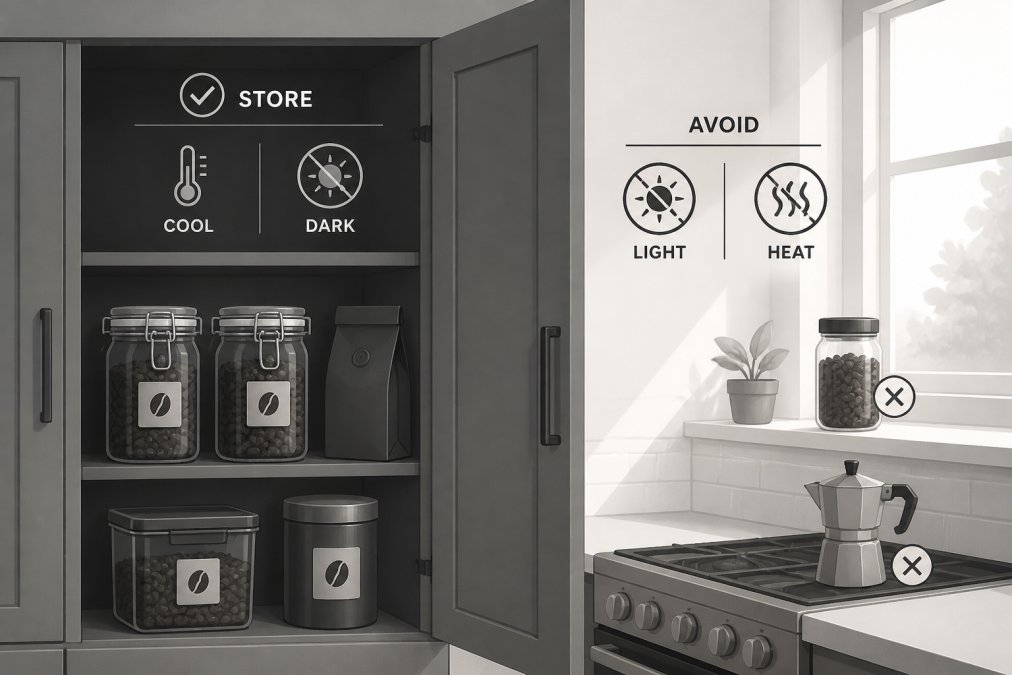
Location matters as much as the storage method. The ideal storage spot is cool, dark, and stable.
Avoid these common mistakes: above or near the stove (heat from cooking accelerates staling), open shelving or countertops (exposed to light and heat), cabinets above the stove or dishwasher (heat rises and moisture accumulates), and near the refrigerator or freezer (exterior heat and temperature fluctuations).
The ideal locations: A cool, dark cupboard or pantry away from heat sources is the gold standard. A basement or wine cooler works if available. The back of a cool closet away from exterior walls can work if the space stays consistently cool.
Room temperature should ideally stay between 60-70°F. If your kitchen tends to be warmer, any cool storage location is better than the counter.
Long-Term Storage for Bulk Buying and Travel
For bulk storage at home:
Buy only what you'll use within 4-6 weeks in room-temperature storage. Freeze the remainder in properly sealed, portion-sized containers. Label frozen containers with the roast date and freezing date to prevent accidentally brewing beans frozen for six months.
If you buy from a roaster like USM Coffee with a subscription service, adjust delivery frequency to match your consumption rate. Receiving smaller shipments more frequently is far better for freshness than one large monthly order.
For travel:
Short trips (under a week): bring beans in a small airtight container. Pack it to prevent crushing.
Longer trips (one to two weeks): bring a week's worth of beans in an airtight container and freeze a second week's worth in a separate sealed bag. Let the frozen portion thaw overnight in the sealed container upon arrival.
Very long trips: consider having beans shipped to your destination rather than traveling with a large quantity.
Humidity matters more during travel. Airplane cabins are extremely dry, which helps preserve beans during flight. However, tropical or humid climates accelerate staling once you land. Store beans extra carefully in humid environments, use smaller containers, reseal frequently, and consider refrigerating (not freezing) if ambient humidity is very high.
Conclusion
Storing fresh coffee beans properly comes down to protecting them from heat, light, moisture, and air. Your original roaster bag, kept in a cool, dark cupboard and folded tightly after each use, is often your best option. If you prefer a separate container, choose one with an airtight seal, complete opacity, and ideally a one-way degassing valve.
Peak flavor lasts roughly 5-30 days after roasting. Freezing extends this window significantly if done correctly, in small portions, sealed until use, and thawed at room temperature. For bulk buying or travel, portion your beans strategically so you're always using relatively fresh stock.
At USM Coffee, we roast beans to order and ship them quickly because freshness is non-negotiable. Our bags are designed with one-way valves and opaque materials to maintain quality from our roastery to your kitchen. Pair our careful roasting with proper storage, and you'll experience the full complexity and aroma that fresh, specialty-grade coffee delivers.
Frequently Asked Questions
How long do fresh coffee beans stay fresh after roasting?
Fresh coffee beans maintain peak flavor for 2-4 weeks after roasting. The freshness window depends on storage conditions, airtight containers in cool, dark spaces extend shelf life toward the four-week mark. After one month, volatile compounds and aromatic oils degrade noticeably, though beans remain drinkable for several more weeks. Check the roast date on your bag to track freshness accurately.
Is it better to store coffee beans in glass or stainless steel?
Stainless steel is superior for coffee storage. Glass allows light exposure, which degrades beans and accelerates oxidation. Opaque stainless steel containers block light completely while remaining airtight. Ceramic with an airtight seal works well too. The key is opacity and an airtight seal, whichever material you choose, ensure it blocks light and minimizes air movement around the beans.
Should you store coffee beans in the freezer or pantry?
A cool, dark pantry or cupboard is ideal for regular consumption. Freezing works for long-term storage (3+ months) if done correctly, use airtight, vacuum-sealed containers to prevent freezer burn and condensation. For weekly or monthly use, pantry storage avoids the condensation risk that occurs when frozen beans warm up. Avoid temperature fluctuations by choosing one consistent storage method.
Will a Ziploc bag keep coffee beans fresh?
Standard Ziploc bags offer minimal protection. They allow air movement and don't block light exposure, both enemies of freshness. If you must use a bag temporarily, squeeze out excess air and store it in an opaque container in a cool cupboard. For proper storage, invest in an airtight container with a one-way degassing valve, these are designed specifically for coffee bean preservation.