

Sustainable Coffee Farming Practices Explained
Table of Contents
- What Sustainable Coffee Farming Actually Means
- Core Environmental Benefits of Sustainable Coffee Farming
- Benefits of Shade-Grown Coffee and Agroforestry
- Fair Trade Coffee vs Organic Coffee Differences
- Economic Viability for Smallholder Farmers
- Key Certifications and Transparency Standards
- How to Support Sustainable Coffee Farming
- Frequently Asked Questions
Last Updated: September 19, 2026
What Sustainable Coffee Farming Actually Means
Sustainable coffee farming is an agricultural approach that balances environmental stewardship, economic viability, and social responsibility in coffee production. It goes beyond simply avoiding harmful practices, it actively restores ecosystems while maintaining profitable yields for farmers.
The distinction matters because conventional coffee farming often strips soil, depletes water resources, and relies heavily on chemical inputs. Sustainable coffee farming practices explained through research show that farmers who adopt these methods typically see improved long-term productivity, reduced input costs, and access to premium markets willing to pay more for responsibly grown beans.
At USM Coffee, we source our beans from trusted farms worldwide, roasting every batch to order to ensure maximum flavor, aroma, and character in every cup. We believe the quality of your coffee starts with how it's grown.
What makes sustainable coffee farming work is integration. Rather than treating soil health, water management, biodiversity, and farmer income as separate concerns, sustainable systems treat them as interconnected. A farm that improves soil fertility naturally reduces pest pressure, which lowers input costs, which increases profitability, all while restoring the ecosystem.
Core Environmental Benefits of Sustainable Coffee Farming
Sustainable coffee farming practices explained in environmental terms reveal concrete benefits that extend far beyond the farm gate. These practices address some of agriculture's most pressing ecological challenges.
Soil Health and Erosion Prevention
Coffee grows best on sloped terrain in tropical regions, which creates natural erosion risk. Conventional farming often accelerates this problem through bare-ground cultivation and monoculture. Sustainable approaches use shade trees, mulching, and minimal tillage to keep soil in place and build organic matter.
Healthy soil holds more water, requires fewer chemical inputs, and produces more resilient plants. The economic benefit comes later, reduced fertilizer costs and longer farm productivity, but the environmental benefit is immediate.
Soil microorganisms thrive in well-managed coffee systems, which improves nutrient cycling and reduces the need for synthetic fertilizers. This creates a positive feedback loop: better soil means healthier plants, which means less disease pressure and lower pesticide requirements.
Biodiversity and Wildlife Habitat Protection
Coffee monocultures are ecological deserts. A single-crop plantation supports minimal wildlife and offers no ecosystem services. Shade-grown and agroforestry systems, by contrast, function as functional ecosystems.
When coffee is grown under native shade trees, the system supports birds, insects, soil organisms, and small mammals. This biodiversity provides natural pest control, pollination, and nutrient cycling that reduces the farmer's dependence on external inputs.
The habitat value extends beyond the farm. Coffee-growing regions in Central America, East Africa, and Southeast Asia overlap with critical biodiversity hotspots. Sustainable coffee farming practices that preserve native vegetation corridors support migratory bird populations and protect endangered species.
Water Management and Conservation
Coffee requires significant water, both for growing the plants and for processing the beans. Conventional processing can generate water pollution through wastewater runoff rich in organic matter and chemicals. Sustainable farms implement water-efficient practices at every stage.
Shade-grown systems reduce water stress on plants through improved soil moisture retention and reduced evaporation. Natural mulch layers keep soil cool and moist, meaning plants need less supplemental irrigation. Processing innovations like honey processing and natural fermentation use less water than traditional fully-washed methods while producing excellent coffee.
Water conservation also protects local communities. In many coffee-growing regions, farms depend on the same water sources as nearby towns and villages. Sustainable practices that reduce water consumption and prevent contamination protect both agricultural productivity and community health.
Benefits of Shade-Grown Coffee and Agroforestry
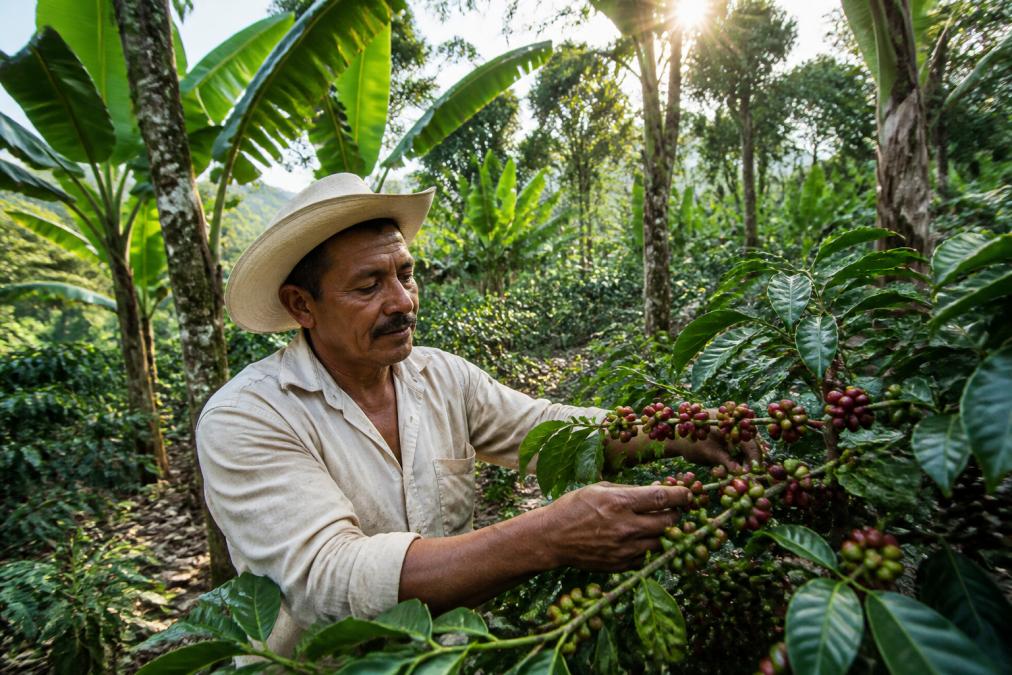
Shade-grown coffee represents one of the most effective sustainable coffee farming practices. Instead of clearing forest to plant coffee in full sun, farmers integrate coffee under a canopy of native or semi-native trees.
This agroforestry approach transforms coffee production from an extractive monoculture into a productive ecosystem. The shade trees provide multiple benefits: they fix nitrogen, prevent erosion, provide food or timber, and create habitat. Coffee plants, shaded from intense sun, develop more slowly and produce beans with greater complexity and depth.
The economic model works because shade trees generate additional income. Farmers can harvest fruit, nuts, or timber from shade trees while the coffee matures. This diversification reduces risk, if coffee prices drop, the farmer still has other revenue sources. It also improves soil health continuously, reducing input costs over time.
Agroforestry specifically describes the intentional integration of trees with crops. In coffee agroforestry, farmers might plant native fruit trees, nitrogen-fixing legumes, or timber species alongside coffee. This requires more planning than monoculture but delivers superior environmental outcomes and often better long-term economics.
The shade-grown coffee model also addresses climate resilience. As temperatures shift and weather becomes more unpredictable, coffee plants under shade stress less and maintain productivity better than sun-exposed plants. The diverse root systems of shade trees also improve soil water-holding capacity, protecting against drought.
Fair Trade Coffee vs Organic Coffee Differences
These two certification systems address different aspects of sustainable coffee farming, and understanding the distinction matters for informed purchasing.
Organic certification focuses on production methods. Organic coffee is grown without synthetic pesticides, herbicides, or fertilizers. Farmers must follow specific soil management and pest control protocols. The certification verifies what's NOT in the coffee, no chemical residues, but doesn't guarantee environmental practices like shade-growing or biodiversity protection.
Fair Trade certification focuses on economic and social equity. Fair Trade standards require minimum prices that guarantee farmer profitability, prohibit child labor, mandate safe working conditions, and often require community investment programs. Fair Trade doesn't specify environmental practices, a Fair Trade coffee could be grown as a monoculture with chemical inputs.
The key difference: organic addresses what's in the coffee; Fair Trade addresses how farmers are treated and paid.
Many consumers assume organic coffee is automatically sustainable and Fair Trade coffee is automatically grown responsibly. Neither assumption holds. The most comprehensively sustainable coffee combines organic production methods, Fair Trade economics, and environmental practices like shade-growing. Some farms achieve all three; others achieve only one or two.
At USM Coffee, we look beyond single certifications. Our sourcing team evaluates farms on multiple dimensions: soil health practices, biodiversity preservation, water management, and farmer compensation. A coffee might carry organic certification, Fair Trade certification, both, or neither, what matters is whether the farm actually demonstrates sustainable practices.
Economic Viability for Smallholder Farmers
Sustainable coffee farming only works if it's profitable for the people growing the coffee. Most coffee globally is produced by smallholder farmers, families farming 5-10 hectares, who operate on thin margins.
The economic challenge is real: sustainable practices often require upfront investment in shade trees, soil amendments, or equipment before generating returns. A farmer planting shade trees waits 2-3 years before harvesting fruit or timber. During that period, they've invested labor and resources without corresponding income.
This is why market access and pricing matter enormously. Farmers who can access specialty coffee markets, where buyers pay premiums for quality and sustainability, can afford to invest in long-term practices. A farmer receiving $2.50 per pound for Fair Trade organic shade-grown coffee can justify the transition costs. A farmer receiving $1.20 per pound cannot.
Cooperative models help address this. When smallholder farmers organize into cooperatives, they gain collective bargaining power, access to shared equipment, and ability to invest in processing infrastructure. Cooperatives can also facilitate direct relationships with roasters and retailers, cutting out middlemen and improving farmer compensation.
The economic viability also improves when practices reduce input costs. A farm with healthy soil needs less fertilizer. A farm with natural pest control needs less pesticide. A farm with diverse income sources (coffee plus fruit plus timber) weathers price volatility better than a coffee-only operation. Over 5-10 years, these cost reductions compound into meaningful profitability improvements.
Technology increasingly supports smallholder economics. Mobile apps help farmers monitor soil health and pest pressure. Weather data improves irrigation decisions. Direct-to-roaster platforms connect farmers with buyers willing to pay premium prices. These tools reduce barriers to sustainable practices.
Key Certifications and Transparency Standards
Multiple certification systems attempt to verify sustainable coffee farming practices. Understanding what each certifies helps you evaluate claims.
Organic certification (USDA in the United States) verifies that coffee was grown without synthetic chemicals.
How to Support Sustainable Coffee Farming
Your purchasing decisions directly influence farming practices. Here's how to make choices that genuinely support sustainability.
Frequently Asked Questions
What is the difference between shade-grown and sun-grown coffee?
Shade-grown coffee is cultivated under a canopy of taller trees, while sun-grown coffee is planted in full sunlight. Shade-grown methods preserve biodiversity, reduce soil erosion, and improve climate resilience for farmers. Sun-grown approaches maximize short-term yield but deplete soil faster and require more chemical inputs. Shade-grown coffee also produces beans with more complex flavor profiles, benefiting both the environment and cup quality.
What certifications should I look for when buying sustainable coffee?
Look for Fair Trade Certified, Rainforest Alliance, and Organic (USDA certified) labels. Each has different standards: Fair Trade ensures farmer pricing and community investment, Rainforest Alliance focuses on environmental and social practices, and Organic prohibits synthetic pesticides. Certifications with supply chain transparency can help you understand the practices in place.
How does sustainable coffee farming impact coffee quality and taste?
Sustainable practices like shade-growing, crop diversification, and soil health management slow coffee cherry maturation, allowing more complex sugars and acids to develop. This creates beans with fuller body, brighter acidity, and more nuanced flavor notes. Farmers who invest in soil fertility and natural pest management avoid chemical residues that can mask origin characteristics. The result is higher-quality coffee that reflects its terroir more accurately than commodity beans.
Why is soil health critical in sustainable coffee production?
Healthy soil holds water during dry seasons, reduces erosion, and provides natural nutrients that reduce fertilizer dependency. Coffee plants grown in degraded soil require more chemical inputs, become vulnerable to climate stress, and produce lower yields. Sustainable practices like composting, cover cropping, and shade-tree integration restore soil fertility and structure. Strong soil also sequesters carbon, helping mitigate climate change while supporting long-term farm productivity and farmer economic stability.