

Why Coffee Tastes Bitter at Home: Fix It Now
Table of Contents
- Why Your Coffee Tastes Bitter
- How to Brew Better Drip Coffee
- Coffee to Water Ratio: Getting It Right
- Ideal Water Temperature for Coffee
- Coffee Grind Size Chart and Adjustments
- How to Fix Bitter Coffee Right Now
- Conclusion
Last Updated: August 17, 2026
Why Your Coffee Tastes Bitter
Bitter coffee at home is almost always preventable. The problem isn't your taste buds or your beans, it's almost certainly one of five things: over-extraction, stale beans, wrong water temperature, improper grind size, or dirty equipment. Understanding why coffee tastes bitter at home is the first step to fixing it.
When coffee grounds stay in contact with water too long, they release compounds that create that harsh, astringent taste. This is over-extraction, and it's the leading cause of bitter coffee. But the fix isn't complicated once you understand what's actually happening in your cup.
Over-extraction and contact time
Over-extraction occurs when hot water pulls too many dissolved solids from your coffee grounds. The longer grounds stay in contact with water, the more compounds dissolve, including bitter tannins and other harsh flavors that ruin the cup.
Think of it this way: the first 30 seconds of brewing extracts the good stuff. The flavor compounds that make coffee taste smooth and balanced come out early. But if you let the grounds steep longer, you're pulling out the compounds that taste like ash and burnt rubber. That's bitterness.
Contact time is the culprit in most home brewing scenarios. With drip coffee makers, many people let grounds sit in hot water for 8-12 minutes. That's excessive. Optimal contact time for drip coffee is typically 4-6 minutes. Pour-over methods should take 3-4 minutes total. French press is the exception, it's designed for longer steeping, usually 4 minutes, but you need a coarser grind to compensate.
The relationship between grind size and contact time is critical. A finer grind increases surface area, so water extracts compounds faster. A coarser grind does the opposite. This is why you can't just use the same grind for every brewing method. Your coffee to water ratio matters too, but contact time is often the overlooked variable that makes the difference between a smooth cup and one that tastes like burnt wood.
Bean quality and freshness matter
Stale beans are the second most common reason why coffee tastes bitter at home. Coffee beans oxidize over time, and oxidation creates compounds that taste acrid and unpleasant. Beans roasted more than 3-4 weeks ago lose their complexity. By 8-12 weeks, they taste flat or bitter.
Fresh-roasted beans make an enormous difference. When beans are roasted to order and delivered quickly, you're tasting the coffee as the roaster intended. Stale grocery store beans have already lost their best flavors, so you're left with the harsh notes that remain.
The processing method also affects how bitter coffee can become. Beans processed using the washed method tend to have more acidity and clarity. Natural process beans have more body and sweetness. If you're buying beans without knowing the processing method, you might be getting beans that are inherently more prone to bitterness if brewed slightly too long.
Storage matters too. Keep beans in an airtight container away from light and heat. Oxygen, light, and temperature fluctuations accelerate oxidation. Many people store beans in the original bag with the valve open, which speeds up staleness. A sealed container in a cool, dark place keeps beans fresher longer.
How to Brew Better Drip Coffee
Drip coffee is the most common brewing method at home, and it's where most bitter coffee problems start. The good news is that better drip coffee requires only three adjustments: clean equipment, correct ratio, and proper temperature.
Step 1: Clean your brewing equipment
Residue buildup in your coffee maker is invisible but significant. Old coffee oils and mineral deposits create a bitter, stale taste that contaminates every new brew. This buildup accumulates in the water lines, heating element, and filter basket.
Clean your drip coffee maker every two weeks. Use white vinegar and water in a 1:1 ratio. Run it through a full brew cycle without coffee. Then run two cycles with fresh water only to rinse out the vinegar. For machines with removable parts, soak the filter basket and carafe in vinegar solution for 30 minutes.
The filter itself matters. Paper filters remove coffee oils, which reduces bitterness. Metal filters let oils through, creating a heavier, sometimes bitter cup. If you use a metal filter, rinse it thoroughly with hot water after each use. Rinse paper filters with hot water before brewing to remove paper dust.
Step 2: Use the right coffee to water ratio
The brew ratio determines extraction yield. Too much coffee grounds relative to water under-extracts, creating a sour, thin cup. Too little over-extracts, creating bitterness. The standard ratio is 1:16, one part coffee to 16 parts water by weight.
This translates to roughly 0.6 ounces of coffee per 10 ounces of water, or about 1-2 tablespoons per 6-ounce cup. But weight is more accurate than volume. A kitchen scale costs under $15 and removes guesswork.
Start at 1:16 and adjust to taste. If it tastes sour, use slightly less water or more coffee. If it tastes bitter, use slightly more water or less coffee. Most people find their preference falls between 1:15 and 1:17.
Step 3: Control water temperature
Water temperature directly affects extraction speed. Water that's too hot over-extracts quickly. Water that's too cool under-extracts. The sweet spot is 195-205°F.
Boiling water is 212°F, too hot. Let water cool for 30 seconds after boiling before pouring. If your coffee maker has a temperature setting, aim for 200°F. Many drip machines don't heat water hot enough, which is why they produce weak or sour coffee, not bitter coffee. But some machines run too hot, which is why they produce bitter results.
If you're using a pour-over, use a thermometer the first few times to dial in your water temperature. Once you know how long to let water cool after boiling, you won't need the thermometer again.
Coffee to Water Ratio: Getting It Right
The coffee to water ratio is the most controllable variable in home brewing. Getting it right eliminates most bitterness problems.
Precision matters here. A 1:16 ratio means if you use 20 grams of coffee, you use 320 grams of water. This consistency is why a kitchen scale is essential. Eyeballing it with tablespoons introduces too much variation.
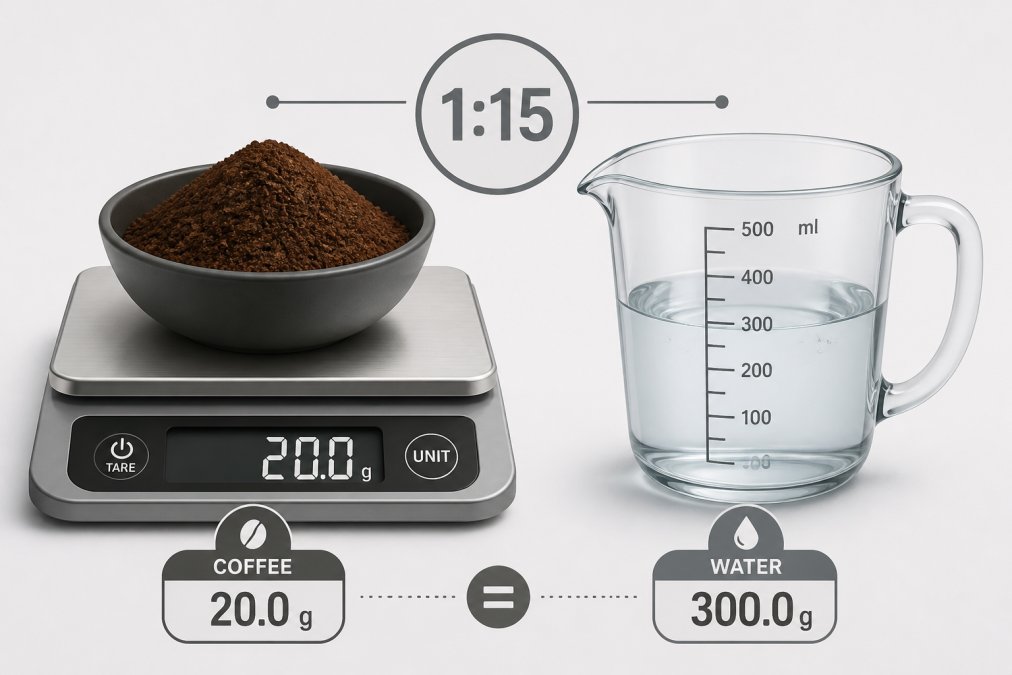
Start with 1:16 as your baseline. Brew, taste, and adjust. If the coffee tastes bitter, increase the water ratio to 1:17 or 1:18. If it tastes sour or weak, decrease to 1:15. Most home brewers find their preference within a few tries.
Different brewing methods tolerate different ratios. Espresso uses a much tighter ratio around 1:2 or 1:3, which requires a finer grind and precise timing. French press works well at 1:15 because the longer contact time compensates for the coarser grind. Pour-over is flexible and works well anywhere from 1:15 to 1:17.
The ratio also depends on your beans. Lighter roasts are denser and extract slightly slower, so they can handle a slightly longer contact time or hotter water. Darker roasts are more porous and extract faster, so they need slightly cooler water or shorter contact time to avoid over-extraction.
Ideal Water Temperature for Coffee
Water temperature is the variable most home brewers ignore, but it's critical for avoiding bitterness.
The ideal range is 195-205°F. At this temperature, water dissolves the right compounds at the right speed. Below 190°F, extraction is too slow and you get sour, under-extracted coffee. Above 210°F, extraction is too fast and you get bitter, over-extracted coffee.
Most drip coffee makers don't display water temperature, so you need to infer it. Boiling water is 212°F. If you pour boiling water directly into grounds, you're at the upper limit of acceptable. Letting it cool for 30-45 seconds gets you to around 200°F, which is ideal.
For pour-over, use a simple thermometer. Heat water to a boil, let it cool for 30 seconds, check the temperature, and adjust your wait time accordingly. Once you know your pattern, you won't need the thermometer every time.
Water hardness affects extraction speed too. Hard water with high mineral content extracts faster because minerals conduct heat differently. If your tap water is very hard, you might need slightly cooler water or shorter contact time. Soft water extracts slower, so you might need slightly hotter water or longer contact time.
The mineral content of your water is called Total Dissolved Solids, or TDS. Water with 150-250 ppm (parts per million) of TDS is considered ideal for coffee brewing. If your tap water is very soft or very hard, you might notice that coffee tastes different than it does elsewhere. This is normal. Adjusting your brewing parameters slightly usually fixes it.
Coffee Grind Size Chart and Adjustments
Grind size determines how fast water extracts compounds from coffee grounds. Finer grinds extract faster. Coarser grinds extract slower.
The chart below shows how grind size matches brewing methods:
| Brewing Method | Grind Size | Particle Size | Typical Contact Time |
|---|---|---|---|
| Espresso | Very Fine | Sand | 25-30 seconds |
| Turkish | Very Fine | Powder | 4-5 minutes |
| AeroPress | Fine | Fine sand | 1-2 minutes |
| Drip Machine | Medium | Granulated sugar | 4-6 minutes |
| Pour-Over | Medium | Granulated sugar | 3-4 minutes |
| French Press | Coarse | Sea salt | 4 minutes |
| Cold Brew | Very Coarse | Peppercorns | 12-24 hours |
If your coffee tastes bitter with a drip machine, the most likely culprit is a grind size that's too fine. Fine grinds in a drip machine create a longer contact time than intended, leading to over-extraction. Moving to a medium grind usually fixes it immediately.
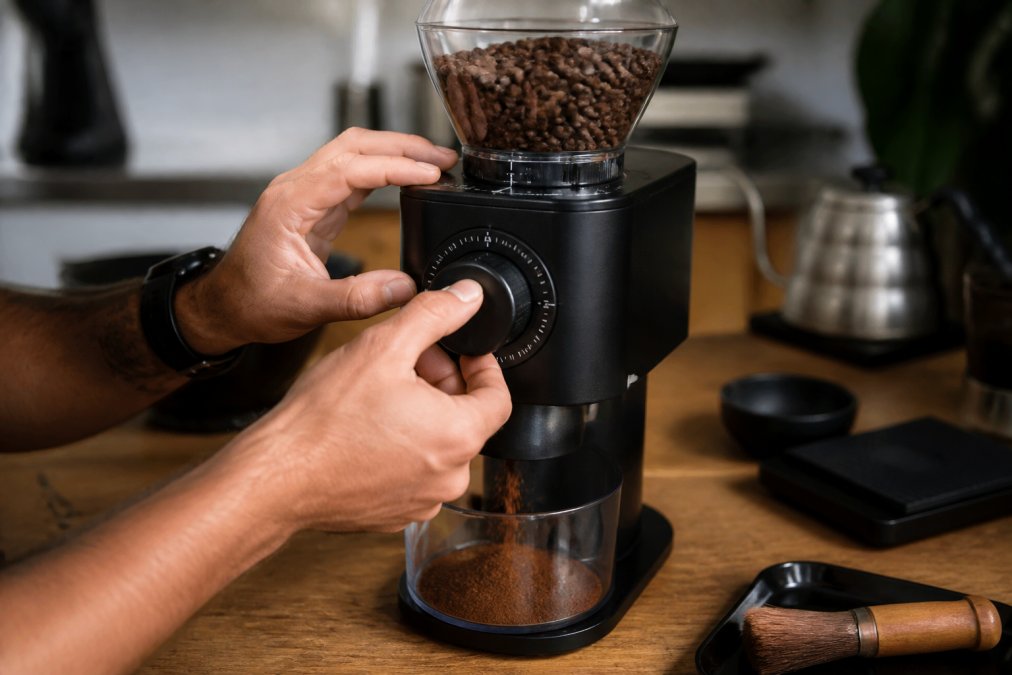
Use a burr grinder, not a blade grinder. Blade grinders produce inconsistent particle sizes, which means some grounds over-extract while others under-extract. This creates an unbalanced, often bitter cup. A burr grinder, either flat burr or conical burr, produces uniform particle size, ensuring consistent extraction.
Adjusting grind size is your fastest troubleshooting tool. If coffee tastes bitter, grind coarser. If it tastes sour, grind finer. Make small adjustments, move one or two settings on your grinder, not a dramatic jump.
How to Fix Bitter Coffee Right Now
If you're drinking bitter coffee today, here's how to fix it immediately.
Quick adjustments to reduce bitterness
The fastest fix is to shorten contact time. If you're using a drip machine, don't let the grounds steep more than 5 minutes. If that's already your practice, grind coarser. A coarser grind slows extraction, counteracting over-extraction.
Lower your water temperature if you can control it. If you're pouring boiling water, let it cool for a full minute before pouring. The difference between 212°F and 200°F is significant.
Reduce the amount of coffee grounds slightly. If you've been using 2 tablespoons per 6-ounce cup, drop to 1.5 tablespoons. This increases your water ratio, diluting the harsh compounds.
Clean your equipment. Even if you cleaned it recently, run a vinegar cycle today. Old residue contributes to bitterness in ways that are hard to isolate otherwise.
Check your water temperature if you have a thermometer. If it's above 205°F, let the water cool longer. If it's below 195°F, you might need hotter water or a finer grind.
When to replace your beans
If your beans are more than 4 weeks old, they're likely stale. Stale beans are harder to diagnose as the problem because many people assume old beans taste weak, not bitter. But oxidized beans develop harsh, acrid flavors that read as bitterness.
Buy fresh beans and brew immediately. The difference is usually dramatic. If you switch to fresh beans and the bitterness disappears, your old beans were the problem.
Store new beans properly. An airtight container in a cool, dark place keeps them fresh for 3-4 weeks. Don't buy more than you can use in a month. For most home brewers, buying beans from a roaster who ships quickly is better than buying from a grocery store where you don't know the roast date.
USM Coffee roasts beans to order and ships them quickly, ensuring you receive beans at peak freshness. Fresh-roasted beans eliminate one major source of bitterness before you even start brewing.
Bitter coffee at home is usually fixable with one small change. Start by adjusting your grind size or contact time, these are the fastest diagnostics. If that doesn't work, check your water temperature or clean your equipment. Most of the time, one of these adjustments solves the problem within a day. If you're still tasting bitterness after trying these fixes, your beans are likely stale. Switching to fresh, properly stored beans usually reveals that your brewing technique was fine all along.
Frequently Asked Questions
Why does my homemade coffee taste bitter?
Bitter coffee at home usually results from over-extraction, where hot water pulls too many compounds from the grounds. This happens when contact time is too long, water temperature is too high, or grind size is too fine. Stale beans also taste more bitter because oxidation breaks down flavor compounds into harsh, ashy notes. Check your brew time, water temperature (aim for 195-205°F), and bean freshness first.
How does grind size impact bitter coffee?
Grind size directly controls extraction speed. Fine grounds expose more surface area, causing faster extraction and over-extraction if steeping too long. Coarse grounds extract more slowly. For drip coffee, use a medium grind, finer than sand but coarser than table salt. If your coffee tastes bitter, try grinding coarser and reducing brew time by 30 seconds. A burr grinder gives consistent particle size, preventing channeling and uneven extraction.
Does water temperature affect coffee bitterness?
Yes. Water temperature dramatically impacts extraction. Too hot (above 205°F) pulls excessive bitter compounds and tannins from grounds. Too cool (below 195°F) under-extracts and tastes sour. Aim for 195-205°F for most brewing methods. If you're using boiling water straight from the kettle, let it cool for 30 seconds before pouring. Water quality also matters, hard water with high mineral content can intensify bitterness, while filtered water produces cleaner, smoother results.
How can fresh beans reduce bitter taste?
Fresh-roasted beans taste smoother because their oils and flavor compounds haven't oxidized. Stale beans (older than 3-4 weeks) develop ashy, burnt flavors that read as bitter no matter how carefully you brew. Store beans in an airtight container away from light and heat. Buy smaller quantities more frequently rather than stockpiling. Beans roasted to order ensure maximum freshness and flavor profile clarity, eliminating the harsh notes common in pre-packaged supermarket coffee.