

French Press vs Pour Over: Flavor Profile Comparison
Table of Contents
- French Press vs Pour Over: Key Flavor Differences
- Mouthfeel and Body: Why French Press Feels Fuller
- Impact of Paper Filters on Coffee Taste
- Coffee Grind Size for French Press vs Pour Over
- How to Brew Better Drip Coffee with Pour Over
- Extraction, Clarity, and Sediment: Understanding the Differences
- Which Method Should You Choose?
- Frequently Asked Questions
Last Updated: September 26, 2026
French Press vs Pour Over: Key Flavor Differences
The choice between a french press and pour over fundamentally shapes what ends up in your cup. Understanding why these methods produce different flavor profiles helps you pick the right one for your beans.
French press prioritizes full-bodied richness by immersing grounds directly in hot water, allowing oils and fine particles to remain. Pour over uses paper or metal filters to create a cleaner, more delicate extraction. Neither is superior, they're fundamentally different approaches.
The difference matters most when you're working with quality beans. Fresh-roasted coffee from sources like specialty coffee farms reveals these nuances dramatically. At USM Coffee, we roast to order specifically to preserve the subtle tasting notes that shine through different brewing methods. A medium roast from Brazil Santos might taste elegant and smooth in a pour over, but full and chocolatey in a french press, same beans, completely different experience.

Paper filters in pour over catch oils and sediment, creating a brighter cup with pronounced acidity and clarity. French press retains those oils, creating heavier mouthfeel and richer body. This distinction determines whether you taste fruity brightness or nutty undertones.
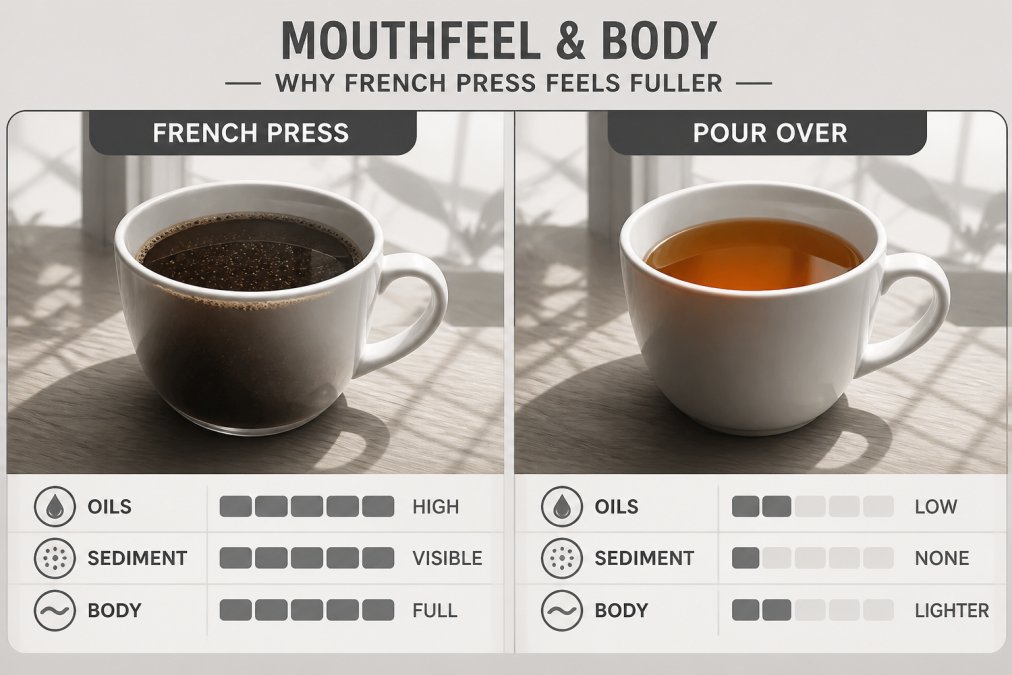
Mouthfeel and Body: Why French Press Feels Fuller
French press produces a noticeably fuller mouthfeel because metal mesh filters don't remove the coffee oils and fine sediment that paper filters catch.
French press keeps coffee oils and fine particles suspended, creating a chewy texture and fuller sensation. Pour over strips out these elements through paper filtration, leaving a cleaner, lighter-bodied cup.
Tasting them back-to-back reveals the difference: French press coats your mouth and lingers; pour over feels crisp and clean. Choose french press for bold, full-bodied coffee, or pour over to taste subtle nuances and individual flavor notes.
Beans with higher oil content, like those from Indonesia or Brazil, taste better in a french press. Lighter beans from Ethiopia or Central America shine in pour over where subtle tasting notes aren't masked by heavy body.
Sediment in french press coffee adds texture and intensity for some, but feels gritty to others. Paper filters eliminate it entirely, which is why pour over appeals to those seeking a cleaner cup.
Impact of Paper Filters on Coffee Taste
Paper filters fundamentally alter what ends up in your cup by removing coffee oils, fine sediment, and certain compounds that pass through metal mesh.
Paper blocks oils and particles while allowing water and dissolved solids through. This reduces diterpenes (compounds in coffee oil) and can reduce irritation for people sensitive to coffee's acidic compounds.
Metal mesh filters don't block oils, so more natural fats reach your cup, enhancing body and mouthfeel. The trade-off: richer flavor and texture, but a less refined cup.
The practical impact: if you're brewing single-origin beans with specific tasting notes, paper filters help those notes shine by removing competing flavors from oils and sediment. If you're brewing a bold blend designed to taste rich and full, a metal filter preserves the intended profile. According to Specialty Coffee Association brewing standards, both methods are valid, the filter choice should match your brewing goals.
Paper filter quality matters: bleached filters can impart a papery taste if not rinsed; unbleached filters may contribute subtle paper notes. Rinse filters with hot water before brewing to eliminate this variable.
Coffee Grind Size for French Press vs Pour Over
French press and pour over require different grind profiles because their brewing mechanisms extract coffee at different rates.
French press demands a coarse, consistent grind because immersion steeping for 4 minutes requires slower extraction. Fine grounds would over-extract and create bitterness; coarse grounds slow extraction for balanced flavor.
Pour over requires a medium-fine grind because water passes through in seconds. Coarse grounds under-extract; medium-fine grounds achieve proper extraction in 2-3 minutes. Chemex requires slightly coarser than a typical drip cone.
Single Origin Favorites Sample Pack →
Grind consistency matters as much as size. Uneven grinds create bitter and sour flavors. Burr grinders produce uniform particles; blade grinders create inconsistent results.
Bitter or astringent means grind is too fine; sour or thin means too coarse. Most people dial in their ideal grind within 2-3 adjustments. Once set, consistency becomes the priority.
| Brewing Method | Ideal Grind Size | Grind Consistency | Brew Time | Extraction Rate |
|---|---|---|---|---|
| French Press | Coarse | Uniform particles | 4 minutes | Slow (immersion) |
| Pour Over | Medium-Fine | Very uniform | 2-3 minutes | Fast (percolation) |
| Chemex | Medium-Coarse | Uniform particles | 3-4 minutes | Moderate (immersion + percolation) |
How to Brew Better Drip Coffee with Pour Over
Pour over technique directly impacts flavor. Small adjustments in water temperature, bloom time, and pour speed transform an average cup into an exceptional one.
Optimal extraction happens between 195-205°F. Heat water to a rolling boil, remove from heat, wait 30 seconds, then brew. This lands you in the ideal range for most beans.
Bloom matters: pour just enough hot water to saturate grounds (roughly twice the weight of dry coffee) and wait 30-45 seconds. This allows CO2 to escape and improves extraction evenness.
Pour slowly in circular motions to keep grounds in contact with water and ensure consistent extraction. Rushing creates channeling and uneven extraction. Slow pouring takes 2-3 minutes total and produces cleaner flavor.
Grind consistency affects flow rate. Too-fast drainage (under 2 minutes) means grounds are too coarse or pour is too aggressive. Too-slow drainage (over 4 minutes) means grind is too fine or water is too cool. Ideal is smooth, steady drainage.
Bleached filters impart minimal flavor; unbleached filters may contribute slight paper notes if not rinsed. Most specialty shops use bleached filters rinsed thoroughly before brewing.
Extraction, Clarity, and Sediment: Understanding the Differences
Extraction is the core difference between these brewing methods. It describes how much of the coffee's soluble compounds dissolve into water. Different methods achieve different extraction levels, which directly determines flavor clarity and sediment presence.
Pour over achieves what specialty coffee professionals call "clean extraction." The paper filter removes oils and fine particles, leaving only dissolved solids in your cup. This produces clarity, you taste individual flavor notes distinctly. A pour over cup of Ethiopian coffee might reveal pear, floral, and jasmine notes separately, rather than blending into a general "fruity" impression. The clarity comes from sediment removal and oil filtration that keeps flavors from competing.
French press achieves what's called "full extraction." The metal mesh allows oils and fine sediment to remain, creating a richer, more complex cup but less clarity. Those same Ethiopian beans in a french press taste more unified, the oils and sediment blend flavors into a cohesive whole. You lose individual note distinction but gain body and mouthfeel.
Sediment in french press coffee isn't a flaw, it's part of the brewing method.
Which Method Should You Choose?
The decision between french press vs pour over comes down to what matters most to you: richness or clarity, convenience or precision, full body or delicate nuance.
Frequently Asked Questions
What are the primary flavor differences between French press and pour over coffee?
French press coffee delivers a full-bodied cup with bold, rich tasting notes because the immersion brewing method allows extended contact between water and grounds, maximizing extraction of oils and sediment. Pour over coffee produces a cleaner, brighter cup with more subtle nuances, the paper filter removes oils and fine particles, highlighting delicate flavor notes like fruity undertones or floral brightness. With USM Coffee's Single Origin Favorites Sample Pack, you can taste these differences directly: try the same origin through both methods to experience how extraction and filtration shape the final cup.
How does grind size impact the flavor profile of French press vs pour over brewing?
Grind size directly controls extraction time and flavor intensity. French press requires a coarse, consistent grind to prevent over-extraction during the 4-minute steeping period; too fine a grind produces bitter, muddy coffee. Pour over demands a medium grind for optimal flow rate and even extraction, too coarse and you get weak, sour coffee; too fine and it becomes astringent. Precision matters: a slight adjustment changes acidity, body, and brightness noticeably. Start with the recommended grind for your method and adjust by one setting at a time to dial in your preferred balance of sweetness and clarity.
Does the paper filter in pour over significantly change the flavor profile?
Yes, paper filters fundamentally alter flavor. They trap diterpenes and coffee oils that would otherwise reach your cup, creating a cleaner mouthfeel and removing the chewy texture associated with French press. This also removes some bitter compounds, making pour over coffee taste brighter and more refined. Metal mesh filters (used in some pour-over designs) retain more oils, producing a body closer to French press while still offering better clarity than immersion brewing. The choice between paper and metal is a personal preference: paper for maximum clarity and subtle tasting notes, metal for a richer body with cleaner sediment control.
Why does French press coffee taste so much better to some people?
French press appeals to those who prefer full-bodied, intense coffee with pronounced chocolate tones, caramel notes, and nutty undertones. The immersion method extracts more soluble compounds, creating a heavier mouthfeel that many experience as richer or more satisfying. However, this same characteristic can taste heavy or oily to others. The answer depends on your preference: if you enjoy bold, complex cups with texture, French press excels. If you prefer clean, bright coffee that showcases origin-specific flavors, pour over wins. USM Coffee's Best Sellers Sample Pack includes blends like Cowboy (cocoa and vanilla tones) that shine through either method, test both to discover your preference.