

How to Maximize Fresh Coffee Aroma: 7 Steps
Table of Contents
- Why Fresh Coffee Aroma Matters
- How to Keep Coffee Beans Fresh Longer
- Best Coffee Storage Containers for Aroma Retention
- Grinding Coffee Beans for Maximum Flavor and Aroma
- Grinding Immediately Before Brewing
- Water Quality and Temperature for Optimal Extraction
- Aroma-Enhancing Brewing Methods
- Troubleshooting Flat or Muted Aromas
- Frequently Asked Questions
Last Updated: September 21, 2026
Why Fresh Coffee Aroma Matters
The aroma you smell when opening a fresh bag of coffee tells you everything about what's inside. That scent comes from volatile compounds released by the roasting process. Once those compounds escape, they're gone forever. Your coffee loses its character, depth, and the sensory experience that makes specialty coffee worth buying.
Most coffee drinkers focus on taste alone and ignore aroma. But aroma and taste are inseparable, your brain processes smell before flavor. When aroma fades, the entire drinking experience suffers.
At USM Coffee, we roast every batch to order specifically to maximize fresh coffee aroma and preserve these volatile compounds at their peak. But roasting is only half the battle. What you do in the first two weeks after receiving your beans determines whether you get that full aromatic experience or a flat, muted cup.
How to Keep Coffee Beans Fresh Longer
Coffee beans start degrading the moment they're roasted. Understanding why helps you protect them better.
Understanding oxidation and degassing
Roasting creates chemical reactions that produce carbon dioxide and aromatic oils. For the first 12-24 hours, beans release CO2 in a process called degassing. The beans are at peak aroma during this window.
After degassing slows, oxidation becomes the enemy. Oxygen reacts with coffee oils, breaking down volatile compounds. This accelerates with light, heat, or air exposure, flattening the aromatic profile and muting tasting notes.
The freshness window after roasting
Most specialty coffee is best consumed within two to four weeks of roasting, your peak aroma window. Volatile compounds are still present and stable; beans haven't yet lost significant aromatic character to oxidation.
After four weeks, aroma degradation accelerates. By eight weeks, most aromatic complexity is gone.
Roast date matters more than expiration date.
Best Coffee Storage Containers for Aroma Retention
Where you store your beans has an enormous impact on aroma retention. The wrong container can destroy freshness in days.
Airtight containers and volatile compound protection
Airtight containers are non-negotiable, oxygen exposure is the primary enemy of aroma. Look for containers with one-way valves that allow CO2 to escape during degassing but prevent oxygen from entering.
If transferring beans, choose a container with a one-way valve. Ziplock bags are better than open storage but inferior to rigid airtight containers.
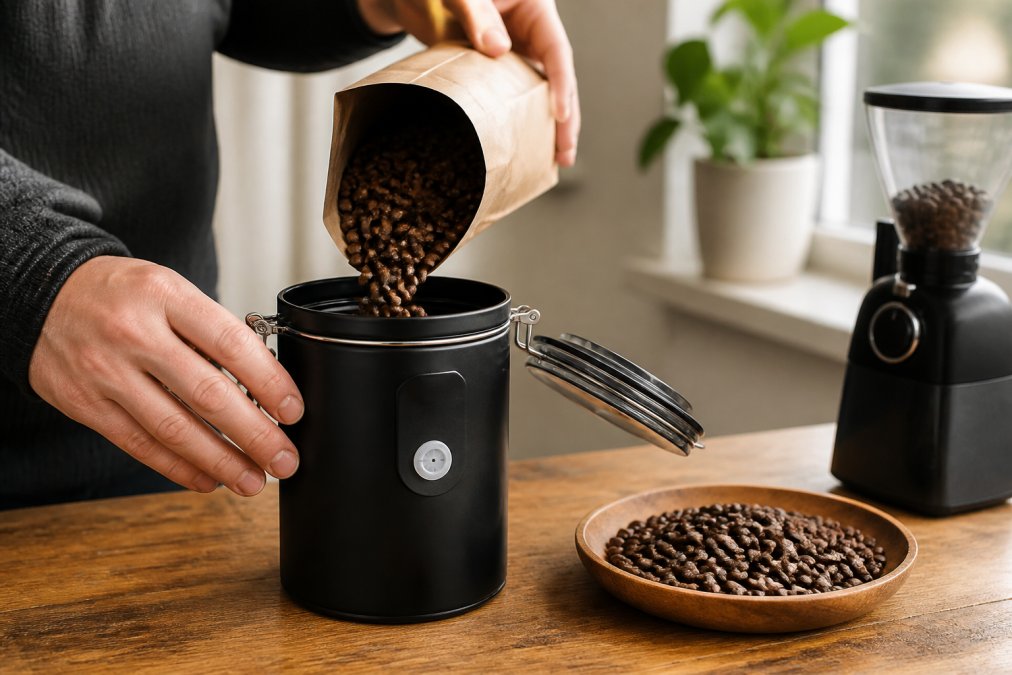
Why opaque, cool storage beats transparent jars
Light degrades aromatic oils through photodegradation. Clear glass jars actively destroy your coffee. Use opaque containers, stainless steel, dark glass, or ceramic.
Heat accelerates oxidation and volatile compound loss. Store beans in a cool, dark place, a pantry or cabinet is ideal. Never use the refrigerator or freezer; temperature fluctuations and moisture cause more damage than cooling provides.
Keep beans away from direct sunlight, heat sources, and strong-smelling foods. Coffee absorbs odors easily.
Grinding Coffee Beans for Maximum Flavor and Aroma
How you grind your beans directly impacts how much aroma reaches your cup.
Burr grinder selection and grind consistency
Blade grinders create uneven particle sizes and generate heat through friction, accelerating volatile compound loss. Burr grinders produce uniform grind sizes with minimal heat.
Uniform grind sizes ensure even extraction, better aroma expression, and balanced flavor.
A burr grinder is the single most impactful tool after sourcing fresh beans.
Grind size impact on aromatic release
Smaller grind sizes increase surface area and extraction of volatile compounds. Grind size must match your brewing method: espresso (fine), pour-over (medium), French press (coarse).
Match your grind to your method to unlock the aroma your beans are capable of delivering.
Most volatile compounds dissolve in the first 30 seconds of brewing. Proper grind size captures this peak window.
Single Origin Favorites Sample Pack →
Grinding Immediately Before Brewing
This is non-negotiable for maximum aroma.
Grinding exposes the interior to oxygen, and volatile compounds escape immediately. After 15 minutes, noticeable aroma loss occurs; after an hour, substantial loss; after 24 hours, most aromatic complexity is gone.
Grind seconds before the water contacts the grounds to preserve maximum volatile compounds.
Water Quality and Temperature for Optimal Extraction
The water you brew with matters as much as the beans themselves.
Minerals in water (calcium and magnesium) facilitate extraction. If your tap water is very hard or very soft, consider a simple filter to optimize extraction.
Water temperature controls extraction speed. The sweet spot is 195-205°F; below 195°F under-extracts, above 205°F over-extracts and pulls bitter compounds.
Most brewing methods benefit from water in this range. Measure your water temperature with a simple thermometer if you're serious about consistency. Small adjustments here yield noticeable improvements in aroma expression.
Aroma-Enhancing Brewing Methods
Different brewing methods physically handle aromatic oils differently. Understanding these differences helps you choose the method that will maximize fresh coffee aroma and the aroma profile you want from your beans.
How paper filters affect aroma expression
Paper filters (used in pour-over, drip, and AeroPress methods) remove coffee oils from the final cup. This sounds negative, but it's actually beneficial for aroma clarity. Coffee oils contain both aromatic compounds and bitter compounds. When oils are removed, the bitter compounds go with them, leaving only the delicate, aromatic notes. The result is a clean, bright cup where floral, fruity, and tea-like aromatics shine through without interference.
Pour-over methods like Chemex and Hario V60 are particularly good at this. The slow pour (3-4 minutes) allows volatile compounds to dissolve gradually into the water while the paper filter catches the oils. You get maximum aromatic clarity with minimal bitterness. The trade-off is that you lose some body and mouthfeel compared to unfiltered methods.
How metal filters preserve aromatic oils
Metal filters (used in French press, Moka pot, and Turkish coffee) allow coffee oils to pass into the cup. These oils carry aromatic compounds, so the cup has a fuller, more intense aromatic presence. The aroma is richer and more complex because you're tasting both the volatile aromatics and the oil-soluble aromatics.
The French press is the classic example. A 4-minute immersion in hot water extracts both water-soluble and oil-soluble aromatic compounds. The metal mesh filter lets the oils through, so you get a cup with maximum aromatic intensity. The trade-off is sediment in the cup and a heavier mouthfeel. Some drinkers prefer this; others find it muddy.
Turkish coffee takes this further. The coffee is ground to a powder, mixed with water and spices, and heated until foam forms. The result is an extremely concentrated, aromatic cup with intense flavor and aroma. The downside is that the fine grounds settle at the bottom, and the brewing method requires skill to avoid boiling over.
How espresso concentrates aroma
Espresso uses high pressure (9 bars) and a short contact time (25-30 seconds) to force hot water through finely ground coffee. The result is a small volume of liquid with an extremely high concentration of aromatic compounds. A single espresso shot (1-2 ounces) contains as much aroma as a full cup of pour-over coffee, just in a smaller volume.
The crema, the tan, foamy layer on top of an espresso shot, is where most of the volatile aromatics concentrate. Crema forms when CO2 and aromatic oils emulsify under pressure. When you smell an espresso shot, you're smelling the crema. This is why espresso has such an intense aromatic presence despite its small size.
The downside is that espresso requires expensive equipment and skill to dial in. A poorly pulled shot (too coarse, too fast) under-extracts and tastes thin. A poorly pulled shot (too fine, too slow) over-extracts and tastes bitter. But when dialed in correctly, espresso delivers the most intense aromatic experience of any brewing method.
Immersion vs. percolation: extraction speed and aroma
Immersion methods (French press, Turkish coffee, cold brew) submerge grounds in water for an extended period.
Choosing a method for your beans
Consistency and repeatability
Troubleshooting Flat or Muted Aromas
If your coffee smells weak or tastes flat, one of these factors is the culprit.
| Step | Action | Impact |
|---|---|---|
| 1 | Buy beans roasted within 2 weeks | Volatile compounds still present |
| 2 | Store in airtight, opaque container | Slows oxidation and light damage |
| 3 | Keep in cool, dark location | Prevents heat and light degradation |
| 4 | Use burr grinder for consistency | Uniform extraction of aromatic compounds |
| 5 | Grind immediately before brewing | Preserves volatile compounds in cup |
| 6 | Brew at 195-205°F | Optimal extraction temperature |
| 7 | Drink within 30 minutes | Captures peak aromatic window |
Frequently Asked Questions
Does grinding coffee beans immediately before brewing improve aroma?
Yes. Grinding immediately before brewing releases volatile compounds trapped inside whole beans. When you grind, you expose the fresh aromatic profile that begins to fade within minutes due to oxidation. A burr grinder produces consistent particle size, which maximizes surface area and allows hot water to extract both aroma and flavor evenly. Grinding 30 seconds to 2 minutes before brewing captures the peak sensory experience.
How does storage affect the aroma of coffee beans?
Storage directly controls how long your beans retain their aromatic profile. Airtight containers in cool, dark places slow oxidation and prevent volatile compounds from escaping. Exposure to air, light, heat, or moisture accelerates degassing and oxidation, flattening aroma within days. The freshness window, typically 2-4 weeks after roasting, narrows dramatically if beans are stored in transparent containers or left open. Proper storage extends the shelf life of aromatic nuances and tasting notes.
What is the best way to maximize fresh coffee aroma at home?
Start with freshly roasted beans and use them within 2-4 weeks. Store them in an opaque, airtight container away from heat and light. Grind just before brewing using a burr grinder set to match your brewing method. Use filtered water heated to 195-205°F, and maintain a proper brew ratio (typically 1:16 coffee to water). These steps work together to preserve volatile compounds, maximize extraction yield, and deliver the full aromatic profile in your cup.
How can I tell if my coffee beans have lost their aroma?
Flat or muted aromas indicate oxidation has progressed. If freshly ground beans produce little smell, or if your brewed coffee tastes dull despite using quality beans, your beans have likely exceeded their freshness window or been stored improperly. Beans stored in transparent containers or at room temperature degrade faster. Check the roast date on your packaging; beans older than 4 weeks typically show noticeably reduced aromatic profile. Switching to fresher beans or improving your storage method will restore the sensory experience.